Sesquipedalians for those who do not suffer from Hippopotomonstrosesquipedaliophobia!

So what’s the longest word in the English language?

I like words. I love to do the New York Times Crossword puzzle which celebrates words, unusual usage and popular American culture. So I care about questions such as: what’s the longest word in the English language?

Well if you include technically strung out words and others artificially created words the list can be arbitrarily long. The chemical name of titin is apparently longer than 189,000 letters. There’s also supercalifragilisticexpialidocious from Mary Poppins which is found in dictionaries nowadays. (Shakespeare apparently used a made up word, Honorificabilitudinitatibus, the longest word that appears in his writings, which is also the longest word that alternates consonants and vowels. )

Then there is Hippopotomonstrosesquipedaliophobia. It means fear of humongously long words, so presumably if you suffer from it you do not use it.

My nominee for the longest nontechnical, everyday word in English is: antidisestablishmentarianism. It consists of 28 letters. Antidisestablishmentarians are people who are opposed to disestablishing the Church of England, which as you know was created by Henry VIII because the Catholic Church wouldn’t let him divorce. Now isn’t that a wonderful word?

It’s, of course, also a sesquipedalian – words that are well hung (or 18 inches long – that’s well hung isn’t it?)

Crossword puzzlers and puzzle makers who cater to them love words like these. Antidisestablishmentarianism is a sheer joy to them. So they must sneak it in as one of their puzzle entries, as the New York Times did last Friday. How do you fit in a 28-letter word into a 15×15 grid? You cheat – multiple letters per square to further challenge and delight your customers. Here’s the puzzle (which I for one thoroughly enjoyed doing):

NYT X-word puzzle using the longest word in English

Happy Crosswording!
Posted in Uncategorized | Leave a comment

A Letter to Obama

Dear Mr. President,

Can we talk?

Your presidency is failing. I voted for you, as did millions of others, because we thought you could arrest our country’s precipitous decline. America desperately needed change when you came into office – we were bleeding economically, losing our credibility internationally and spending our money and sacrificing our men on the most pointless and ineptly run war.

Now we are stuck in a hopelessly deadlocked debate on our budget and on how to manage our burgeoning debt. It is not an honest debate, Mr. President. It is being driven by special interests and ideology. The Republicans do not want a solution, they want power. They want you to fail.

But you have been strangely ineffective. You seem desperate for compromise, for debate and consensus before we move anywhere.

And you are being eaten alive. The same thing happened on Healthcare Reform. You did not lead, instead you started a debate and thought the best ideas would emerge and be adopted.

Not so.

The other side realizes that in Politics perception is reality and they have shamelessly trumpeted lies and prevailed. Truth is not self-evident, Mr. President – you have to communicate it. Even blatant lies, when marketed by skillful, well-funded zealots become accepted truth. Have you not seen the egregious examples of these: that you were born abroad, that you are a muslim, that you are communist, corrupt, evil Kenyan seed, an Anti-American foreign agent, yada, yada, yada? People are willing to trumpet these lies because they see you as weak, not willing to fight and because by delegitimizing you they can feather their ambitions and their pockets.

Now they are demagoging you on the Federal Debt. Once again you have not led and they are getting away with laying down the law. And with astonishingly bold lies. And what do you do? Set up endless debates to forge “consensus” like the so called bipartisan “Budget Ceiling Talks” (with VP Biden presiding). This is not leadership and cannot achieve anything. The talks have predictably failed.

Stop debating, Mr. President! There is a perfectly reasonable solution that a bi-partisan commission that you set up came up with. Yes, you set it up. It was your idea and they came up with eye-popping, sensible recommendations to fix the budget mess. I’m talking about the Fiscal Commission chaired by Erskine Bowles (Dem) and Alan Simpson (Rep). See here for details of what they came up with.

Simpson Bowles - Bipartisan Budget Solution

The Commissions recommendations are bold and sweeping and utterly sensible. They spare no one. They suggest reforming: defense, favorite tax subsidies for corporations, tax loopholes, social security, entitlements, discretionary spending etc in a responsible and workable way.

Just the way you had instructed them to do. The recommendations are truly bipartisan – they cause some pain on both sides of the aisle.

And if these recommendations are adopted we will see our deficit shrink to 2.5% of GDP in 8 years, better than any other proposal on the table, including Paul Ryan’s hatchet job. It will make our deficit the second smallest of all industrialized nations!

So I’m perplexed, Mr. President. Why haven’t you pushed this? It was your idea. You could take well deserved political credit for it and it fit with your desire to reduce partisanship. It is a solution embraced by all neutral observers, economists and pundits.

Mr. President, this is what you must do. End the endless bickering right now. Let’s not cherry pick ideas and debate them to death. Let’s not talk about Corporate Jet subsidies and punishing oil companies or billionaires in isolation. Let’s not create even more dug-in positions and a dangerous game of chicken with our debt ceiling. All you have to do is get solidly behind your own bipartisan Commission’s plan. Use your wonderful gift of communication to convey its benefits and common sense to the American people, to your party naysayers and to the Republican ideologues. Announce that there is no room for unbundling and discussing the package’s recommendations in isolation. There is shared pain here but it is a minimal pain solution to our dire debt problem.

You will have solved the hardest problem this country faces.

Yes, you can!

Sincerely,

A Supporter

Posted in Money, Uncategorized | 3 Comments

Science? Please, I’m Republican!

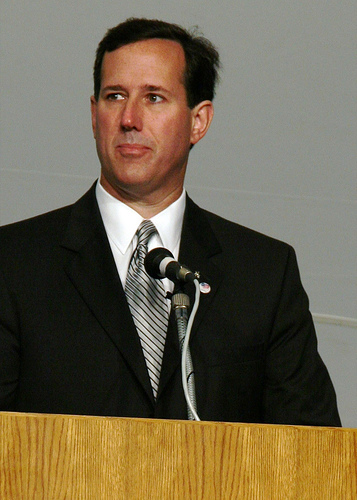
Rick Santorum. Not Fooled by that “Science” stuff!

Mitt Romney today opined that Climate Change is real.

Retribution was swift. The Republican ignorance machine went into overdrive. Crosses were waved, exorcisms were performed. They finally settled for a scarlet “S” carved on his chest.

Sickening.

Here’s what Rick Santorum, the latest declared presidential candidate for the Republican Party, said:

I believe the Earth gets warmer, and I also believe the Earth gets cooler. And I think history points out that it does that. The idea that man, through the production of CO2 — which is a trace gas in the atmosphere, and the man-made part of that trace gas is itself a trace gas — uh, is somehow responsible for climate change is, I think, just patently absurd when you consider all of the other factors — El Niño, La Niña, sunspots, uh, uh, you know, moisture in the air — there’s a variety of factors that contribute to the earth warming.To me there is opportunity for the left — it’s a beautifully concocted scheme. It’s been on a warming trend so they said, ‘Oh, let’s take advantage of that and say that we need the government to come in and regulate your life some more because it’s getting warmer.’ Just like they did in the ’70s when it was getting cooler, they needed the government to come in and regulate your life because it was getting cooler. It’s just an excuse for more government control of your life and I’ve never been for any scheme or even accepted the junk science behind the whole narrative.

Pretty amazing that in our country a presidential candidate from a major party can get away with such aggressive ignorance. It seems that the constant presence of Sarah Palin and her word throw-ups has made ignorance chic again – nay a requirement – if you want to run as a Republican!

Mitt Romney, who has been trying to dumb himself down to meet his party’s requirements by denying his major achievement in Massachusetts – the Universal Health Care plan that is essentially identical with “Obamacare” – couldn’t quite go far enough. So he said today that he did believe the world’s scientists’ virtually unanimous claim that we have  Global Warming and that it was man made.

The response was immediate and merciless! Rush Limbaugh, the Republican chastity tester, immediately declared that Mitt Romney had committed suicide. You will not sully our party with science, d’ya hear! “Mitt Romney”, said Limbaugh, “had bought into the biggest hoax of the century, the Climate Change Conspiracy, to take control of the free market system of the world.”

Enter Rick Santorum, spouting the Republican-endorsed mumbo jumbo. Watch here:

If any candidate in Europe or even Asia, Africa or South America said what Santorum is saying, I wonder how long his political career would last. Everywhere but in Tea Party America this would be considered gibberish.

Today I read in the newspaper that Iran has authorized its traffic police, when making routine stops, to arrest people for not dressing with Islamic modesty. Ironically the same day, today,  Alabama has passed a new law making it a criminal offense to give an undocumented alien a ride in your vehicle. Traffic police can arrest you if your passenger turns out to have insufficient papers to justify being in the U.S. I guess Alabama has a ways to go equal Iran – it hasn’t stipulated a Southern Baptist dress code yet.

I read too that 80% of the people in Pakistan believe that 9/11 was a hoax. With our Republicans I think only about 70% think the climate debate is a hoax. The Republicans, to their credit, are still not at Talibanic levels yet.

Oh, let’s give them time. They’ll get there.

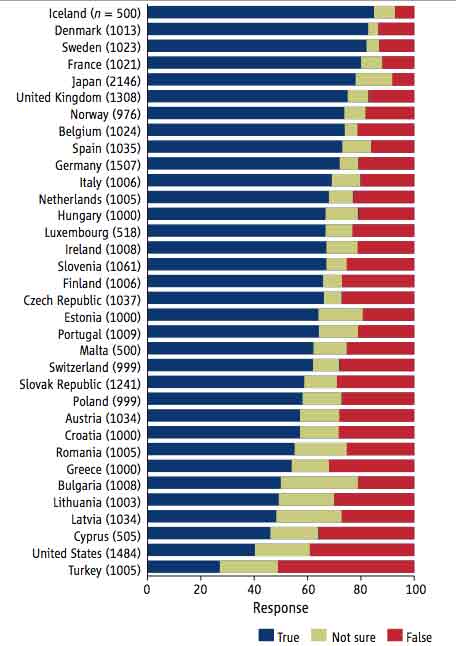
The chart below shows the level of acceptance of Evolution in developed countries:

People Accepting Evolution as Valid Science

It shows that only 39% of Americans accept Evolution as fact – a level below almost every country in the developed world.

We are at the vanguard of reversing the gains of Enlightenment, which brought the West out of the dark ages. Thanks to the Republicans we are now leading the world back into medieval times – maybe the Taliban and the Republicans have a lot of common goals!

Posted in Uncategorized | Leave a comment

Better Dow Betters Do Time!

How Now, Dow!


In a previous blog I gave away an open investing secret – that you can make great returns simply by putting all your money in the simplest of all market indices, The Dow Jones Industrials Average, or Dow as we fondly call it. If you do that you will beat almost all professionally managed mutual funds or even private wealth funds (without special access or inside information). And you will beat all your friends, guaranteed.

Here are some historic numbers going back to 1940:

Average of returns when invested in the Dow for randomly selected  holding periods of

1-Year:    11.95%

5-Years:    70.02%   (Annualized return: 11.20%)

7-Years:    110.64%   (Annualized return: 11.32%)

10-Years:    193.02%   (Annualized return: 11.35%)

20-Years:    741.83%   (Annualized return: 11.24%)

Notice the consistent annualized return of about 11.3%, regardless of the holding period. In this study I took randomly selected 100 starting dates for the investment and held each one to the stated holding period adding in dividends when received. Then I averaged all the returns to get the above numbers.

The annualized expected return is the same regardless of how long you hold the investment. However here’s another interesting number – the number of the 100 holding periods where I lost money. Take a look:

Number of times I lost money (out of 100 random tries) for holding periods of:

1-Year:    22

5-Years:    6

7-Years:    2

20-Years:  0

Mind boggling. In the period from 1940 to 2011 we have had bubbles, crashes, wars, stagflation, the oil crises, the dotcom bust and the financial meltdown of 2008 – and yet only 2% of the time would you lose your money if you held the Dow for a randomly selected 7 year period! This reveals another interesting characteristic of the Dow. If you don’t need the money in the immediate future and are willing to lock in your investment for some years,  you reduce the investment risk to bond-like levels without losing the annual return of about 11.3% compounded! (For the numerically minded, the annual sigma for the Dow held for 7 years is: 6%, versus 16% for a one-year holding period. 7-year corporate bonds are 4-8% sigma – with much lower returns, of course)

Below is a chart showing returns for 7-year holdings since 1940 (buying the Dow at the beginning of each year and selling at the end of 7 years – including dividends, of course):

As you can see we had only one period out of 64 where we lost money – in the seventies malaise – and even that was a small loss.

Over a 20-year holding period the chart was even more amazing. We never failed to double our money in any period!

So the moral of the story – if you can afford to lock up your money invest it in the Dow, reinvest the dividends and forget it. You will get the benefit of highly reduced risk due to time diversification and you will most likely beat all professionally managed funds. You will have to spend minimal time managing your money and can go on and have a life free of worry.

If you are a twenty-five year old starting a career say and want to contribute regularly to an IRA, where should you invest your money? REIT’s, Palladium futures, gold coins, Google or Netflix? No, invest it in the boring index, the Dow. By the time you are 60 and eligible to withdraw you will have a fortune, accumulating tax deferred and compounding at an 11.3% annual rate through all the ups and downs of the economy!

Posted in Uncategorized | Leave a comment

VAT Dreams

An ancient Indian sage (Tulsidas) once said that the most benign government was one that:

when it showered its citizens with benefits it felt like bountiful rain and when it taxed its citizens it was imperceptible like the evaporation of moisture.

Our government’s tax and benefits system is decidedly not so. What self-respecting civilization would design a tax code that is 75,000 pages and costs the country $431 billion annually to administer?  Our tax code is complex, unfair, damaging to our economy, and its thousands of pages of code are completely beyond understanding by all but a few highly specialized lawyers and accountants! 

There is a simple answer – one so simple that I don’t think we’ll ever adopt it. Unfortunately there’s too much vested interest in the status quo. But let’s dream for a moment and see what this proposed solution could do for us.

Imagine a tax system where:

  • The tax code consists of less than a dozen pages.
  • You never have to file a return.
  • You have to keep no records of your incomes, medical records, stock purchases and sales, interest payments and receipts. No records period.
  • Tax cheating is virtually impossible, no need for costly enforcements and tax courts and rulings.
  • There are no payroll taxes, individual or corporate.
  • You don’t have a thicket of different types of incomes – ordinary, short and long term capital gains, active and passive, earned or unearned, yada, yada, yada…
  • No gas depletion benefits, no depreciation and amortization, no taxes on foreign income, no inventory taxes, no LIFO, FIFO or fee-fi-fo-fum.

And no social engineering of any kind using the tax code. It would minimize government interference in our lives while still providing revenue for government functions – a dream for conservatives who sleep with a copy of Ayn Rand under their pillows.

Sounds awesome, so what is it?

I’m talking about a kind of National Sales Tax, or more precisely a Value Added Tax (or VAT) where the tax would be assessed at each stage of manufacturing on the amount of value added and passed on to the next stage. For this to work it will have to completely replace (not augment) our current system of income based tax. Paul O’Neill, the treasury secretary under “W”, made a great case for it but could not succeed. An excerpt from what he said a couple of weeks ago

…  if we had something simple … like a VAT or a consumption-based tax,  we would reassure the markets that we’re coming back and create the basis for capital formation and savings …

President Bush fired O’Neill for being too radical and opposing his tax cut for the wealthy in 2003. Here’s what O’Neill said:

No. In fact, I was strongly opposed to the Bush tax cut that was enacted in 2003, and it’s one of the reasons I got fired. You know, between that and saying there was no evidence of weapons of mass destruction in Iraq, those were pretty significant causes to get fired, which I was happy to get fired for, because I was pretty convinced that the third tax cut didn’t make sense ..

Okay, that was an aside, an obiter dictum to my main case, as it were.

What kind of rate would we need to supplant all our tax collection? The amount that our Federal government needs to spend every year is estimated (at zero long term deficits) to be about 19% of GDP including all entitlements such as Social Security, Medicare, welfare, unemployment benefits etc. So a VAT of about 20% would do it.

Pros and Cons of VAT

Pros

There are many big advantages to having a VAT (other than the bulleted points mentioned above). The biggest one in my opinion is that it will let the Market allocate capital and make economic decisions. Today, with pathologically skewed benefits built into our tax code, capital is misallocated with billions of dollars lost in the process (in addition to the $431 billion used up on accountants, tax lawyers and enforcements)

The second biggest advantage is the nonvolatility of revenues. With an income based tax system, as we have today, the tax revenues soar when GDP is up (disproportionately) and sink when there is a recession. So when our our GDP grows by say 3% the tax revenues rise by 15% and if the GDP falls by 3% revenues tank by 15 -30%! In boom times the government gets a bonanza and builds in spending programs beyond their means. In bust times the revenues dry up and huge deficits are racked up. See my blog about boom and bust cycles. With VAT the tax revenues rise and fall roughly in line with GDP so they are much more stable and predictable allowing much better allocations.

A third major advantage is the ease with which a sales tax can be implemented and the high degree of compliance.

Cons of VAT

An oft stated disadvantage of VAT is that it is considered non progressive. It is said that the poor spend more of their income buying things than the rich who have the luxury of saving. So someone earning, say, $25,000 a year, who would spend most of their income, would pay sales tax on all their income. In contrast someone earning $1,000,000 may spend only a fraction of their income, investing or saving the rest, and therefore will pay taxes on a smaller portion of income.

There are ways to make the VAT as progressive as is desirable in our society. Here are two steps that can be taken:

1. No VAT on food items. Since the less prosperous spend more of their income proportionately on food and rent,  they would pay taxes on a much smaller percentage of earnings.

2.  We can devise a system where the poor can file for a tax credit to further ease the VAT burden on them. A tax credit for the very poor based on income – for those earning $25,000 per year, say. This way only a small number of people eligible for a tax credit would need to file (and it wouldn’t be mandatory). Remember that our other welfare programs would still be in effect to help the poor.

As for the very rich not consuming but saving. That doesn’t really effect progressivity. When they save they are producing productive assets for society increasing buying power and taxes. Ultimately they will spend their savings or give them to others to spend. Zero sum effect in the long run!

A bigger perceived negative is that it gives the government easy money and that they will institute income taxes anyway in addition to the VAT. Perhaps it is this fear that keeps VAT from being implemented.

I don’t think so. I think we don’t implement it because the wealthy and powerful know that they cannot dodge taxes with a VAT. They cannot game the system as they do with the current dizzyingly complex tax code.

And in America money still outshouts common sense.
Posted in Money, Uncategorized | Leave a comment

One Man’s Meat …

Vegetarians are regarded as being a bit strange in our culture. At par with animal lovers, crazy hippies, tree huggers, religious kooks and effeminate men. “Real” men eat hamburgers, so the macho slogan goes. Those who find the slaughter of animals barbaric are just not man enough. But moral aversion aside is it OK for 7 billion humans to eat at the top of the food chain?

Now everyone knows that burning a lot of coal or oil releases tons of greenhouse gases and adversely effects our environment. But a huge source of environmental degradation has gotten a free pass – the consumption of meat.

So let’s be nerdy for a while. What are the real costs of eating meat and are they sustainable? I’m sure everyone knows that 1 Calorie from meat requires a greater input than 1 Calorie from vegetarian sources. How much and what does humankind burn in relation to the capacity of our planet?

Well, here are some numbers: There are 7 billion people on earth, burning about 2000 Calories per day (each of us is like a 100 watt bulb that is on all the time). Converting to KWH per year we burn 6 trillion Kilowatt-hours of energy every year just to live and breathe. If we get all this energy from vegetarian sources we need 2 Cals of input for every Calorie we eat so we use up about 12 trillion KWH/yr. From meat and other non-veg sources the input is 20 – 30 times greater, so we would burn 25-40 trillion KWH/year if about 10% of our calories came from these sources. Compare with the total electricity production in the world last year:  17 trillion KWH.

Here’s an excerpt from the Feb. 29, 2009 issue of The Scientific American:

The FAO report found that current production levels of meat contribute between 14 and 22 percent of the 36 billion tons of “CO2-equivalent” greenhouse gases the world produces every year. It turns out that producing half a pound of hamburger for someone’s lunch a patty of meat the size of two decks of cards releases as much greenhouse gas into the atmosphere as driving a 3,000-pound car nearly 10 miles.

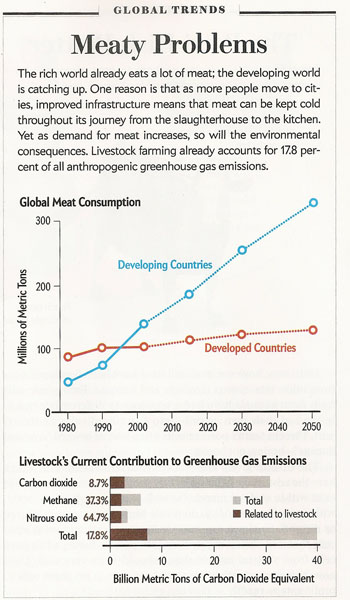
So how much meat is the world consuming? The following chart illustrates:

With increased standards of living around the globe and rapid urbanization we expect meat consumption to triple in the next generation. We will be consuming 300 million tons of meat per year in 2050 and will account for 40% of all human CO2 emissions! (At 18% currently).

Apart from the environmental degradation this level of consumption is unsustainable from the point of view of the long term carrying capacity of the earth.

There is a reason why the numbers of prey animals on our earth are substantially larger than the predator animals. It takes a very large number of prey to feed those at the top of the food chain. For example it takes a population of about 600 million seals to sustain about 20,000 polar bears. Any more polar bears and the seal population will start declining, eventually starving the polar bear population and bringing it back to equilibrium. It is also the reason that the animals at the top of the food chain – tigers, polar bears, lions etc are always endangered more than the animals at the bottom.

Then there is the issue of fresh water availability for our burgeoning population. Fresh water is the ultimate scarce resource and as one scientific publication recently put it:

A water crisis of catastrophic proportions is about to explode.

A huge amount of water is required to produce meat. One pound of wheat has a water footprint of about 150 gallons. One pound of beef: 1500 gallons. By comparison we humans  need about 15 gallons of water/month for our bodily functions. If we eat 1 lb of beef per month we are utilizing a water footprint that consumes upto 100 times the water we require to live for that month!

Another excerpt (this from Discover Magazine)

It takes about 155 gallons of water on average to grow a pound of wheat. So the virtual water of this pound of wheat is 155 gallons. For a pound of meat, the virtual water is 5 to 10 times higher. There’s a virtual water count for everything. The virtual water footprint of a cup of coffee is 37 gallons; an apple, 19 gallons; a banana, 27; a slice of bread, 10  …..

So the bottom line is that for us humans to live at the top of the food chain is unsustainable. It is not a matter of morality, it is a matter of the survival of our planet and of us humans on it.

I am not suggesting that the world should become vegetarian overnight. But a sensible earth policy must include viable vegetarian substitutes for meat. Our food industry and food policy should give us easy access to tasty protein sources packaged in palatable ways – foods made out of soya beans, quinoa, lentils, amaranth, kale and the like – with recipes that meet the requirements of the Western palate, or other tastes around the world. If we are willing to take serious action in reducing the CO2 footprint then a sustainable food policy (and a retraining of our palates) has to be an essential part of it.

The fact that non-meat sources are also non-carcinogenic and good for longevity and our chemical good health (hormones, immune system etc.) will make this even more of a win-win situation.

Posted in Uncategorized | 2 Comments

Debt Crisis 101

Dire. That’s the word used to characterize the U. S. debt crisis these days. Our total debt will reach $14.3 trillion this month and the federal deficit for this year alone is estimated at $1.6 trillion, the highest ever. What’s going on and what’s the answer?

To understand the debt a very fundamental aspect of our market-driven economy must be understood – the boom-and-bust cycle. If you don’t understand this you are not qualified to complain about the debt crisis.

Essentially a free capitalist system has a built-in trend-amplifying feedback loop. By this I mean that when we are in a growth phase there is an artificial boost to the growth pressures driven by high returns and speculation. So, for example, when the housing market is soaring, as it was in the late nineties and early half of the 2000’s, lots of speculative money flows into housing, increasing prices even beyond normal. People take on more debt or buy and  turnover multiple properties to make fast money. The same thing happens in other sectors – dotcom companies, or tulips (in 17th century Holland) to name two. This is a classic bubble or boom.

The opposite happens during the downward part of an economic cycle. Now the trend-amplifying feedback loop accelerates the downturn. As valuations fall people default, sell in panic or get their margin calls causing an acceleration of selling. Companies retrench and the contraction feeds on itself. A classic bust or bubble burst results. We’ve had two big ones in the last 20 years – the dotcom burst (cost $2 trillion) and the gigantic tsunami of 2008, the financial meltdown (cost about $10 trillion!).

Economists have long understood this fundamental instability in a free market system. This is one of the flaws with capitalism, which in general is the most efficient way to allocate capital and engender competition, but has side effects and quirks that must be managed.

Two quirks that all rational analysts agree need active controlling are a tendency for companies becoming too big to fail (or too big to need to compete) and the boom-and-bust cycle. The solution for the former has been to not allow monopolies and the creation of antitrust laws. The solution to the boom-and-bust cycle has been Keynesian fiscal action by the Federal government to cancel out the self-amplifying and destabilizing feedback loop that causes bubbles and crashes.

Keynesian economics requires that when the economy is forming a bubble the federal government should take actions to keep it from overheating. This can be done via Monetary policy (actions by the Federal Reserve, such as increasing interest rates and making capital more expensive) or through Fiscal policy (raising some taxes, decreasing government spending etc.). The reverse should be done when the economy is in a bust mode to prevent a painful and sustained recession. Taxes must be lowered in the teeth of lowered revenues and spending must be increased even when we are facing large deficits.

If we don’t understand this and take the wrong actions we can greatly exacerbate the cycle and cause havoc. In 2000 at the tail end of the Clinton 8 years we had had a classical boom cycle. The economy was growing at a phenomenal clip – 22 million new jobs had been created in less than a decade and we had a budget surplus. Federal tax collection had jumped to 20.6% of GDP. See my previous post for more. The dotcom bubble was forming and the stock market had soared. The NASDAQ index stood at a vaporous 5050 – almost twice what it is today, 11 years later. This was a time where Keynesian economic prudence would suggest we needed to put some brakes on.

In came the Bush administration. The new President said that the surpluses meant that we could return a dividend to the people and cut taxes. He didn’t do the recommended Keynesian thing which would have been to keep the surpluses and reduce overall federal debt when the economy did not need a boost. He also increased government spending enormously by initiating major wars and implementing expensive social policy such as the drugs program in Medicare. So we had  a big time deficit – a stimulus even as the economy was being artificially boosted by war and unneeded profligacy. Our debt started ballooning during an expansion, leaving us less margin when we would need to deficit spend in a crash. We were belt-expanding when belt tightening was needed! About $6 trillion of excess government debt and spending was created during an expanding economy to pump even more air into a bloating bubble!

When this horribly bloated bubble burst (as they all must, for trees don’t grow to the sky) it was cataclysmic.

The speed with which the financial system collapsed was breathtaking – institutions such as Lehman Brothers, AIG, Merrill Lynch etc were bankrupt. Banks such as Citicorp, Deutchebank, Bank of America had negative net worths in the trillions! If nothing was done the consequences would be a wipe out of virtually the entire financial system – peoples’ savings decimated, pension plans destroyed, mutual funds with hugely negative values, corporate debt defaults resulting in major bankruptcies of blue chips like GE and not so blue chips like the S&P 500 companies. We had a debacle where we ran the risk of a once-in-a-century depression – maybe 30% unemployment and even breadlines!

In such a situation only the Federal government could avert catastrophe. They had to act fast and there was no precedent to guide them. Within a matter of hours the government had to inject huge amounts of liquidity into the system to arrest a free downfall. They didn’t do it with skill and finesse – how could they, no one knew what to do? But they did manage to arrest the free fall. Many large institutions were indeed saved and banks rejuvenated. But all this came at a great cost. Tax revenues had fallen by more than 30% because of the crash and spending had to be increased, first to avoid financial havoc and secondly in welfare expenditures such as unemployment benefits.

So now we have this ginormous deficit, to use the vernacular. But what caused it? Certainly not the actions that we had to take to get out of the train wreck. No, the debt crisis is a result of previous administrations’ actions that allowed this huge bubble to form and the $10 trillion  bust that ensued.

What should we do now? Well, firstly, all options available to us will have a cost. We have to pay for the unpaid splurge that the financial sector enjoyed. Who will pay is what we must collectively decide.

Our economy continues to be sluggish as we are coming out of the crash slowly. At this stage we should continue some stimulus (as Nobel prize winning economist and an expert on recessions, Paul Krugman, convincingly argues) and lowered taxes even at the expense of a larger debt. Obama is right in not raising taxes right away. In fact he has quietly executed a huge Keynesian boost by cutting the payroll taxes for two years. Payroll taxes are the largest component of taxes right now and provide the largest economic fillip.

But we will come out of this downturn soon enough. We will revert to a mini-boom cycle. Already corporate profits have grown 15% or more for 6 quarters and the Dow is at almost pre-crash levels. Tax revenues have increased dramatically already easing the deficit a tad. When the economy no longer needs mouth-to-mouth resuscitation we should concentrate on repaying the debt – significantly reassess taxes on the rich, who have come out relatively ahead in this cycle and cut government spending. The President’s bipartisan Debt Reduction Commission, headed by Erskine Bowles and Alan Simpson have an excellent blueprint for how to do this. (Note to Prez: Mr. Obama please push this.)

We have a huge deficit right now. No question about it. At $1.6 trillion it is the largest this country has seen. But the fact is that 60% of this, or about $950 billion is lost revenues because of the deep bust and the rest is forced spending in the worst recession of our lifetime. This is not to say we don’t have waste in government spending – but the wrong-headed actions that led to an oversized speculative bubble followed by a horrible bust are the biggest catastrophe that we have suffered.

If we really feel that our debt crisis is dire we ought to take steps as outlined above instead of playing debt-ceiling chicken while spouting ideological nonsense, as our clueless Speaker Boehner and his zealots in Congress are doing.

The stakes are indeed dire.

Posted in Uncategorized | Leave a comment

Easy Money – Yes, But Not Where You Think.

I was watching CNBC (the financial network) the other day (I’ve got to kick that habit, this kind of TV really is bad for you). Up came a viewer survey: How many of you are beating the Dow Jones (Industrial Average) in your investing?

38% of the respondents said they were beating the Dow. Another 30% or so were performing at “about the same level” as the Dow.

Wow! Really? The ability of people to go Rah Rah about their investing is astounding. It must be a psychological thing that people want to remember only their good investments, or want to show that they are good investors because that is the easy achievement that Wall Street is touting.

On the same financial channel we now have a daily hour-long segment on making money through Options trading – there’s a trader sitting there telling you how to establish Butterfly spreads or what naked options to write to maximize your “take” from this market. Then there’s this ad for Day Trading. A serious, fast-talking guy is earnestly telling you to “Just call and we’ll rush you a packet of Day Trading strategies that are right 86% of the time”. Many of his clients have retired in just three months of using his method, working just 15 minutes a day from home. Presumably they’ve quit their jobs, exchanged their wives for younger, sexy starlets and sit all day on some beach sipping Mai Tais! Capitalism is so great!

Truth is that most investors lose money on professional advice and almost everything you see on CNBC, The Wall Street Journal etc. is financial pseudoscience designed to lure you into a crooked Wall Street casino. A great recent article in Scientific American documents the flimflammery that goes with Wall Street experts claims of beating the market. It cites a well publicized incident where, in a dramatic visual demonstration on TV, John Stossel (who had a television special on skepticism on Fox Business News) threw 30 darts into a page of stocks and compared the results with the picks of the 10 largest managed funds. Results: Dartboard gain 31%, Managed Funds – 9.5%.

The article goes on to say:

A study in the journal Economics and Portfolio Strategy that tracked 452 managed funds from 1990 to 2009, found that only 13 beat the market average.

Wall Street is selling Main Street on the belief that experts can consistently  beat the market. They can’t. No one can. Not even professional economists. If they can’t the average CNBC viewer has zero chance.

Truth is that to beat the market you need specialized information. The stock market is a giant poker game where short term winners can only persistently exist at the expense of losers. Specialized information, available to a few insiders, need not be illegal, although, as evidenced by the recent Galleon Hedge fund conviction of Rajaratnam, it often is. But you can have specialized information through sophisticated “quant” models or data mining or as in the case of large firms like Goldman Sachs through a vast, private inflow of deals and client activities data. There are about $3 Trillion  in Hedge funds in the U.S. today and most of them operate in a private, unregulated trading environment. I highly recommend reading Sebastian Mallaby’s book, More Money than God: Hedge Funds and the Making of a New Elite about this secretive subculture of the financial industry that is in the zero sum game of moving large amounts of money from one pile to another and making huge returns in the process. Guess who the counterparties are to these zero sum games – yes, the ordinary Joe who tries investing himself or gives his money to professionals to manage.

By the way 85% of all trading on Wall Street is done by computers with direct access to the trading “floor”. The efficacy of these systems is often dependent on their “latency” measured in microseconds as the lag time between order placement and receipt by the trading floor computer. So if you’re operating on a longer lag time than a few microseconds you might be losing the edge!

But before you despair there is a winning strategy for you. It is simple, takes less than even the fifteen minutes a day, and even though you won’t retire in 6 months or even 5 years, over the last 30 years it has yielded 40 times the original investment with low fluctuations and risk. It beats California real estate and virtually every other stock buying/selling strategy no matter how sophisticated (not grounded in fraud or exceptional luck).

Three years ago, in a blog titled, An Almost Unbelievable Investment, I talked about this investment. Yes, we are talking about investing in the Dow Jones Industrial Average – the index itself. Since I wrote the blog there has been a severe market crash and the Dow saw its biggest decline in more than a generation. It’s time to revisit how this investment would do, so here’s a current chart showing its performance since 1977.

The Dow has returned a compounded return of 11.75% over the last 34 years. $10,000 invested in the index in 1977 will have grown to over $450,000 today! This beats the portfolios of everyone I know. How did yours do?

I will write more on the Dow and its amazing, simple-to-implement investing potential in a detailed follow-on blog. But for now please read my original article – much of what I wrote is still applicable – you can’t beat a simple index like Dow with all the flimflam in the world that Wall Street gurus will sell you.

Posted in Uncategorized | 7 Comments

The Wrath Pak

Pakistani General and army chief, Ashfaq Kayani, today said that:

he would not tolerate a repeat of the American covert operation that killed Osama bin Laden

Further he said that

he had decided that the number of American military personnel in Pakistan were to be reduced “to the minimum essential“.

General Kayani - Pak Pooh-Bah

No pretense here at all about who is running Pakistan. The General decides foreign policy and who stays in Pakistan and who is expelled. At will he contradicts his own Prime Minister, who in a Washington Post article said the Osama raid was a joint effort and that Pakistan had collaborated in its success.

This is symptomatic of what is wrong with Pakistan. For 36 of its 63 year existence Pakistan has been ruled directly by its Army Chief. And for the remaining time (as you can glean from Kayani’s blusterous statement) the weak civilian leadership shuts up and listens when the Army Chief directs.

Today, Kirin Aziz Chaudhry was reporting on KQED’s Forum that Anti-American sentiment in Pakistan, which is always high,  was ”palpable“ in the streets there. Standard modus operandi – a whipped up fever-pitch hysteria against the West (and also India) continues unabated to justify huge expenditures on defense (25% of all government spending) and giving up all rational say in how to build an open, democratic society.

Truth is we are acting out a charade of being allies with Pakistan. Both sides continue this charade because it suits their limited-perspective objectives. Pakistan (read: Pakistani Military) gets its billions which it immediately diverts to lining its brass’ pockets and buying weapons, expanding its nuclear arsenal and the like (while we look away) and we get access to the country for our intelligence and terrorist monitoring/control activities. In important aspects the Pakistani military and its intelligence agency actually hinders this fight against the terrorists – by actively shielding the key leaders and passing on word on the American plans and capabilities to them. This much is obvious to everyone by now and we will have to come up with a way to engage with Pakistan given this reality.

Another looming threat to us is in Pakistan’s alliance with China. Recently in Kabul Pakistan told Afghanistan’s Karzai to dump the West and join up with it and China to form a new world bloc. ”China“, said one Pakistani spokesperson, ”does not occupy muslim countries like Afghanistan and is not avid like the West in capturing those deemed islamic terrorists. Let them be the world’s policemen – why should we listen to a failing country like America?”

There is much we will have to do to reassess our strategic direction. The Pentagon’s recent  National Strategic Narrative has it dead on (also see my blog, Obama, Oh Bummer!):

It is time for America to re-focus our national interests and principles through a long lens on the global environment of tomorrow. It is time to move beyond a strategy of containment to a strategy of sustainment (sustainability); from an emphasis on power and control to an emphasis on strength and influence; from a defensive posture of exclusion, to a proactive posture of engagement. We must recognize that security means more than defense, and sustaining security requires adaptation and evolution, the leverage of converging interests and interdependencies. To grow we must accept that competitors are not necessarily adversaries, and that a winner does not demand a loser. We must regain our credibility as a leader among peers, a beacon of hope, rather than an island fortress. It is only by balancing our interests with our principles that we can truly hope to sustain our growth as a nation and to restore our credibility as a world leader.

At this point I agree with one Pakistani anti-American commentator who said, “You’ve got your man! Now leave.” I think we should. What we would lose would be less than what we would gain by focussing on our core strategic interests.

Posted in Uncategorized | Leave a comment

Viagra to the Rescue!

I woke up this morning as my radio alarm went off. It happened to be tuned to KPFA in Berkeley and they have been broadcasting interesting stories from the Al Jazeera English network. It is quite amazing how internatinal and broad-based this Qatar based TV station has become. There was Sue Turton reporting from Benghazi and what she said shook me awake.

So what do you do when your soldiers have been ordered to rape all female protestors between the ages of 5 and 40 as Turton reports Khadhafi has done? What if your soldiers can’t perform in the heat of battle as it were? Maybe they have ED (Empathy toward Demonstrators?). Why, you give them Viagra.

That’s what apparently the Libyan Military forces have done in bucketfuls. Viagra is being found in tanks and other vehicles used by the Khadhafi army. Great going, Muammar!

See a You Tube video of Sue Turton’s report here. You will be shocked.

Posted in Uncategorized | Leave a comment