
How to Pay for the Jobs Bill

Depression Era Family

Around 1935, President Roosevelt, faced with the depth of the Great Depression, created a Jobs and Social Security Program to stabilize the American economy. He introduced some bold new initiatives:

Social Security
Public Works Administration
Federal Deposit Insurance Corporation
Rural Electrification Administration
Tennessee Valley Authority
Civilian Conservation Corps
Agricultural Adjustment Administration

to name a few.

Was this Socialism? The start of the nanny state? Soviet-style State Central Planning? There is much revisionist history about this, but the truth is the programs were hugely successful and transformed America into a world superpower. We were in a horrible depression: 20+% unemployment (see graph on right), bread lines, national pessimism about the future and the rise of the Communist Party in America which may have had more than 200,000 card carrying members.

The Roosevelt programs reversed the downward spiral and eventually resulted in an economic gusher, full of vigor and Free Enterprise. All this while we had the rise of the Labor Movement providing decent wages and benefits for our workers, and a phenomenal rise in the American Middle Class. The Great Depression was thus reversed, and once reversed American businesses and the capitalist system prospered to make us a world leader in economic, moral and military power. How did Roosevelt pay for all this and what is the lesson for us as we find ourselves in a similar situation?

First, we need a direct job creation program by the Government. Cutting marginal taxes, gutting environmental and safety rules, or eliminating social programs is not the answer. We have a demand implosion and boosting supply will not work. Ah, you say another big government program. How will you pay for this when we have this huge debt program? I am emphatically for responsible borrowing and living within our means, but unfortunately, we didn’t do that when we needed to and when the economy was bloating up during the Bush era, and now we are forced to deficit spend to avert a disaster.

Here’s how you pay for this. President Obama should present this analysis to the Nation when he explains how we’ll pay for his jobs proposal.

Each $1 billion per year spent by the government  for direct jobs creation results in 14,000 jobs. We have 2,000,000 construction workers looking for jobs while in 2007 The American Society of Civil Engineers estimated that $1.7 trillion was  required merely to stabilize the condition of core infrastructure. If all the needs are factored in—including new water supplies, a modernized continental rail system, a modernized electricity supply, and so on, the costs then add up to $8-9 trillion.

So say we spend $500 billion over five years ($100 billion/year) to create just a fraction of the much needed infrastructure and other (research, innovation, enterprise, education and retraining) projects. Here’s how the numbers shape out:

Expenditures
Expenditure over five years: $520 billion, including 20 billion in interest payment.

Direct jobs created for 5 years: 1.4 million (at 14,000 per $billion)

Direct Receipts and Returns
Tax Revenues (at $5000 per job/year):       $35 billion
Unemployment and Welfare Payments Saved ($20,000 per person employed):   $140 billion

So we’ll get $175 billion out of $520 billion back over five years in direct revenues.

Indirect Receipts
The 1.4 million new workers will spend the money they earn and feed it back into the economy and further job creation. This is called the Velocity of Money. If the velocity of money is a very conservative 2 times, it would be like the $100 billion we injected will result in $100 billion further boost. (During the Great Depression the velocity was estimated to be above 3.5 times. It goes up during bad economic times.) The chart on the right shows the current velocity to be above 2. This means another 1.4 million jobs and government receipts of another $175 billion!

So we now have paid for $350 billion of the $520 billion we spent ($175 billion times 2). But wait there are other benefits.

What about the infrastructure we built with the 1.4 million newly employed construction workers and others. Isn’t that a return to the tax payer? How to measure this return on our investment? It’s a bit more hazy. I would say that for each dollar spent by government let us assume they only produce 70 cents worth of infrastructure – the rest goes in inefficiency, government waste, decisional delays etc. So we get $500 billion times 0.70 or $350 billion worth of infrastructure.

We have more than paid for the $500 billion jobs investment! Also jobs created: 2.8 million.

When the economy recovers, as it did in 1940 for Roosevelt, we must go back to serious debt reduction. We have to keep taxes at a rational level – the Clinton era low but sensible levels will do. Also we have to reduce government spending then and bank the growth dividend from our job creation bill.

There are many other secondary benefits of this kind of spending by government. We reduce house foreclosures, reduce social instability and restore our credibility in being able to pay our huge debt.

If we seriously wish to pursue this line of reasoning and agree that our situation with jobs needs drastic action then I would advocate building a separate Agency (or even several Agencies) for jobs creation a la Roosevelt and give it the mandate to get us out of this economic crisis. This is completely contrary to the prevailing mood, but the prevailing mood is a politically manipulated ideological construct. Hopefully we can muster the strength to rise above it.

Mr. Obama, do you have the persuasive powers?

Posted in Money, Politics | 13 Comments

The Radical Right’s “American Exceptionalism”

One of the distinguishing features of Gorge Orwell’s dystopian classic, 1984, was the minimization and distortion of  language. So bondage and tyranny were called “liberation”, blatant propaganda was spread by the “Ministry of Truth”, War was waged by the  “Ministry for Peace” and reason was called “thoughtcrime” etc.

A similar thing is happening today from the far right. It started with Sarah Palin and her sneering portraiture of Obama as a “community organizer”, or her description of end-of-life-counseling as “death panels”. The Tea Party, of course took this on and now words have simply ceased to have meaning. They have been debased and rendered hideous. It’s like the difference when the word “love” is used by the Dalai Lama say, or by Dracula as he seduces his victim. Same word, not the same meaning.

I was reminded of this horrible phenomenon as I read Shelby Steele’s column in the Wall Street Journal today. He was brandishing the phrase American Exceptionalism in a way the radical right in this country has usurped it, to mean “We cannot be judged or do anything wrong because we are exceptional. We must make everyone in the world bend to our will and are so exceptional that we need never reflect on the complexities of a changing world or the limits to our own power. We must go forth with blazing guns, telling the world to take their UN, or NATO or Old Europe, or World Court or even Science and what-not and shove it. It is our manifest destiny to lead, enshrined in us by God himself, and we need merely say this to become the shiny beacon that we say we are.”

To the far right ideologues American Exceptionalism (a term coined by Alexis de Tocqueville in the 1830’s when he saw our incredible democracy) now means a kind of macho – real America is a hamburger-eating, gold-chain-wearing man with balls. It doesn’t wear sweaters or eat quiche or indulge in reflection, or ever admit any wrong. As in Orwell’s 1984 the uplifting connotation of the word Exceptionalism has been turned on its head by the radical right and converted to narcissism, jingoism, cultural insensitivity, mediocrity and knee-jerk contempt for new ideas.

Here is an excerpt from Shelby Steele’s op-ed:

Mr. Obama did not explicitly run on an anti-exceptionalism platform. Yet once he was elected it became clear that his idea of how and where to apply presidential power was shaped precisely by this brand of liberalism. There was his devotion to big government, his passion for redistribution, and his scolding and scapegoating of Wall Street—as if his mandate was somehow to overcome, or at least subdue, American capitalism itself. And he has launched an assault on America’s bedrock exceptionalism of military, economic and cultural pre-eminence?

This then is how to bash Obama – he’s for Big Government, for redistribution and anti-business and Wall Street. He’s destroying the military and our cultural pre-eminence. Really. No proof needed, it’s self-evident. He’s doing all this because Shelby and his ilk say so.

So here’s a dictionary to decipher some of the code words in here. The idea is that Obama is an anti-exceptionalist liberal (presumably a redundant phrase because one means the other).

Big Government: Democrats. They want a government for all the people and for public welfare  – socialist stuff like healthcare, unemployment bennies, child nutrition and the like!  We can’t afford that.  Too many wars going on.

Individualism:  The Law of the Jungle. If you don’t make it it’s your own ineptitude and laziness. Quit whining. A true American sleeps with Ayn Rand’s Atlas Shrugged under his pillow – wards off nightmares from not having a job.

Passion for Redistribution: Inability to see American Greed for what it is – a sign of American capitalist pre-eminence. True Obama has only lowered taxes so far but heck, his passion is to soak the rich. America now has the most lop-sided income distribution in the developed world, but so what? We are exceptional and Obama doesn’t understand.

Regulation and Scapegoating of Free Enterprise: Free people don’t heed no stinking badges. Rules hinder America and its bedrock pre-eminence. The current economic debacle is not the fault of too few rules or the private sector – Obama stop bashing business. American Exceptionalism guarantees that we will prosper if we could just get the government out of the way. Obama can never understand this because he is, well, you know, different. If he was one of us he would gut silly rules protecting ordinary people or the environment as if we were somehow not exceptional.

Cultural Relativism: God gave us absolute truth. Obey and no whining. Don’t need Obama’s triangulation of the absolute: tolerance of homosexuality, birth control. Family values are not negotiable. What got us here:  submission to the husband and belief in creation and a day of judgment. God said nothing about curbing guns, cleaning the rivers, or paying unemployment benefits.

And why did such exceptional people elect Obama. Mr. Steele has an explanation:

Clearly Americans were looking for a new kind of exceptionalism in him (a black president would show America to have achieved near perfect social mobility).

Americans wanted to prove to themselves that they were exceptional by letting a colored guy become prez. Very similar to why God created sin. So that he could have man freely select righteousness having seen that sin leads to no good.

Posted in Politics, Uncategorized | 1 Comment

Libyan War of Liberation – A Success Story

As news pours in about the freedom-seeking rebels closing in on Tripoli a mere five months after the attack on Benghazi, I was thinking of the momentous changes that we have helped with in the Arab world and what a different model we have used than the one in Iraq and Afghanistan. We are on the verge of overthrowing a tyrant in Libya – a tyrant every bit as evil as Saddam was. Muammer Khaddafi’s 42 year reign of terror is coming to an end. Unlike Iraq this war was fought exactly right. Here are some numbers to ponder:

American deaths:

Iraq War                  4500
Afghanistan War    1600
Libyan War             0

Cost to the U.S. (so far)

Iraq War                         $800 billion
Afghanistan  War          $450 billion
Libyan War                    $1      billion

What a difference a war of liberation fought right makes!

Make no mistake – the Libyan rebels and NATO could not have done it without American help. Obama, after taking his time building a consensus with our European allies and with the Arab League, decided to go to war but with America in the back seat to NATO who would have operational responsibility. This was March 18, 2011. The no-fly zone was established entirely by American air power – no other country has the capability. The execution of the support operations involved extensive American military power including drones and intelligence. The only thing missing, in typical Obama fashion was the jingoistic talk and American ground troops.

Our power was projected quietly, discreetly and effectively. Only five months later the tyrannical Libyan dictator is effectively ousted. This is now a victory that belongs to the Libyan rebels. It is not tainted, as the Iraq war is, as being an American war for oil or an American occupation of a Muslim land.

Good leadership and execution! Of course the Republicans, McCain and Lindsay Graham, while touting the ouster of Khaddafi still had this to say:

We regret that this success was so long in coming due to the failure of the United States to employ the full weight of our airpower.

Amazing! The Libyan freedom fighters won in 5 months! Our airpower was there when needed. The victory had the necessary empowerment of the Libyan people and the Arab street. Civilian casualties were minimal and the siege and massacre of Benghazi was prevented. It was perfect! Can’t these ideologues show some grace?

Any chance that the Republicans will credit Obama with saving $1 trillion in government spending (over the next 10 years, the Congress debt debate time frame) by not getting embroiled in Libya Iraq style?

Posted in Uncategorized | 8 Comments

Gold as a Thermometer for the Economy’s Fever

Have you heard of Peter Schiff?

Peter Schiff's Crash Proof

He runs an unusual brokerage company called Euro Pacific Capital which can get you investments you can’t get into elsewhere, like Australian stocks/CDs and physical gold. He is someone widely derided by the conventional financial gurus as being too doomsday about the U.S. economy. Yet he has been right about the 2008 economic collapse and right about recommending dumping the dollar and buying gold. I think his book, Crash Proof, published in 2007 was dead on and he diagnoses with uncanny insight.

Peter Schiff is warning of an upcoming dollar collapse and severe distress in the Treasury market.

In his periodic video blogs he has been harping on his themes with data and analysis to back himself up. His latest video blog is worth watching. See here.

Some key themes:

S&P was right to downgrade US Treasuries. Only they didn’t downgrade enough

Ironically, people rushed out of stocks and into treasuries, after the downgrade. The dumb money fled to treasuries (at an insane 2% return for a 10-year note) and the smart money fled to gold.

Gold is like a thermometer which gives the temperature of the patient (in this case the US economy). At $1600/ ounce it was telling us that the patient has 106 degree fever. No doctor trying to treat a patient can ignore this vital sign. It is telling us of a dire condition that is being under appreciated.

The patient has now got sicker as gold is selling at over $1800/ounce. Maybe it’s time for the cautious and those who must protect against short (perhaps short term) distress to take heed and get some protection in the form of stable currencies (Australian, Canadian and Swiss) and gold. His brokerage can do so, but a lesser solution is to do it via iShares ETF’s.

Your comments are welcome.

Posted in Money, Uncategorized | Leave a comment

Are Taxes too High?

Chart from Center for American Progress

I received a very informative link to ten telling charts about U.S. taxes, from my friend Ashok Chandra that I wish to share.

Our taxes are the lowest they have been since 1950! Corporate taxes have been falling precipitously for decades. The only tax that has gone up is the Payroll tax, which accounts for 60% of all federal taxes in 2010 and is paid by those earning less than about $100K.

Do take a look, it might surprise you.

On another note if you didn’t catch it listen to Senator Alan Simpson’s interview on NPR this morning you simply must hear it.

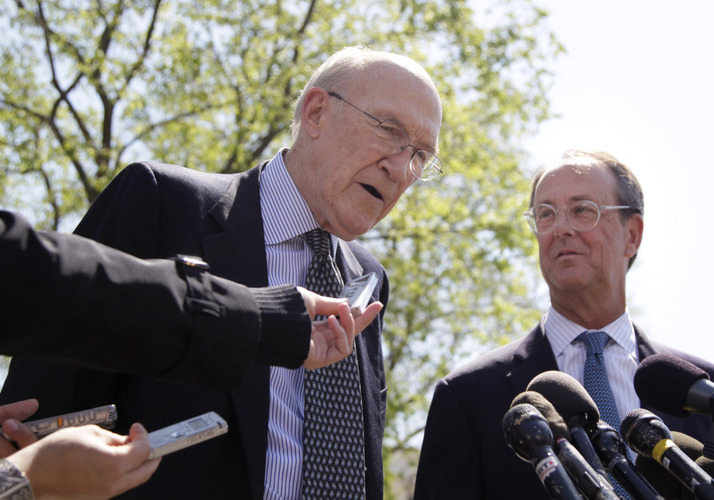
Alan Simpson and Erskine Bowles talking to reporters.

Along with Erskine Bowles, Simpson was the co-chair of President Obama’s fiscal commission. Simpson said they spent 10 months looking for real solutions and they put out a 67 page report with specifics. It was titled The Moment of Truth and it includes suggestions on how to reform the tax code to close loopholes for the very wealthy and includes reforms to entitlement programs including things that would prove highly unpopular like tying the retirement age to rising life expectancy.

He remains articulate and has the gift of turning a colorful metaphor. Here’s what he said about how painful our choices are going to be if we want to fix our debt crisis:

“It’s going to be like giving dry birth to a porcupine.”

There’s still time for Obama to endorse it. Or maybe the Super panel that will convene as part of the budget compromise. What are the odds?

Posted in Money, Politics, Uncategorized | Leave a comment

America Downgrades Itself!

Yesterday the inevitable happened. S&P downgraded U.S. debt from AAA to AA+. It was a stunning case of self-inflicted pain by a dangerously dysfunctional government. They were ably aided by a media that is incapable of analysis and perspective, so simply reports the finger pointing that goes on in Washington. as “he said, she said”.

Early indications are that stock markets around the world may plummet on Monday. Already Israel, whose markets trade Sunday through Thursday, dived 5% as it opened on Sunday and had to be shut down for a huge imbalance in trade. As of this writing the Asian markets have not opened but futures trading suggests a massacre.

S&P cited Washington’s inability to manage its fiscal policies as evidence of the huge risk in our ability to pay on our obligations. China, our biggest debtor, expressed extreme contempt for our political processes and called for a further moving away from the dollar as the world currency.

Fareed Zakaria pointed out today on his show that if the downgrade of our debt results in just a 1% rise in interest rates our deficit will increase by a whopping $1.3 Trillion over 10 years, more than the entire amount of cuts agreed to in the asinine “compromise” that was foisted by Congress upon us last Tuesday.

We are playing with fire with no possibility of a solution and no voice from those who understand the subtleties of economics or our debt structure and markets.

The U.S. clearly needs a structural change in the way the government operates, in the way our checks and balances have simply led to paralysis and inaction.

Consider this:

About 80% of Obama’s nominees for Treasury and other finance related senior positions in the government have languished in the Senate. The Senate, often by one senator taking blocking action alone, has failed to even get an up-or-down vote on these nominees.

More than 30 Federal judge Obama-nominees have not been confirmed, leaving the court system gridlocked and without leadership.

Only 36 bills have been passed by lawmakers and signed by Obama into law since the 2011 Congress came in. The lowest in American history by far for any comparable period in history. Essential government business simply isn’t getting done.

The filibuster, which used to be employed once or twice in a whole presidential term is now used to thwart 80% of the legislation that comes before the Senate.

The Senate has not passed a budget in over 800 days!

We have to take away the day-to-day authority of Congress to manage our fiscal economy. They are incapable, politically-driven, lobby bought and intellectually empty. We already do this in the Monetary arena – the Federal Reserve is independent of the rest of the government in its ongoing decisions. Although the Congress can hold hearings and force the Fed to explain its actions it cannot compel monetary policy or gridlock it.

Why not do the same thing for fiscal policy? Why not create a Federal Fiscal Authority (or FFA), with its chair and members appointed for, say, 8 years like Bernanke is now (or even 12 years to keep it independent of the political process). Then the FFA can have the responsibility and the power to make major decisions relating to:

The Budget Ceiling
Spending authority
The Tax Code

Yes, the Congress and the Administration could still make big decisions like going to war or healthcare policy, but the FFA would set the fiscal policy on how to tax, borrow and manage deficits to meet these obligations. They would be above lobbying and largely neutral in ideology and therefore would carry the force of an impartial referee in making fiscal decisions. We would also be able to make tough choices and much needed and sweeping simplifications to our tax code, such as a national sales tax, without the political impossibility that surrounds sane action now.

We already do this in the monetary policy area and it works far better than if Congress were doing it. Far, far better.

Now there’s a constitutional amendment that would be worthwhile! What say you, Tea Party?

Posted in Money, Politics, Uncategorized | 2 Comments

How to Invest in the Coming Market Debacle

The Dow, Last 10 days

As I write this the global stock markets have shed $4.3 Trillion in the last 10 trading days!

It’s pretty clear that Financial Disaster looms here in the U.S. I wrote a month ago that all the dysfunctions that caused the horrendous crash of 2008/2009 still persist, perhaps even in magnified form. In addition the our inability to come up with a sensible government plan to lift us out of an imploding demand-based recession now ensures that we will head to economic suicide.

Even the mild reform of the banking sector, whose excesses were largely the cause of the $20+ trillion debacle, passed last year as The Dodd–Frank Wall Street Reform and Consumer Protection Act has been now killed by the coalition of big bank lobby money and our willing and complicit right-wing pols.

But enough venting. I want to write about some ideas on how to invest in this environment while protecting yourself from ruin. As you know I believe that in the long run if you invest in America’s largest and most globally diversified companies (in the form of the 30 Dow Jones Industrials) you will beat almost every other strategy. You are very, very likely to get double digit annual returns over a complete economic cycle or a 10-20 year investing horizon. See my post here on why and how to invest in the Dow Index.

But in the near future the clouds of doom loom – it would not surprise me if the Dow falls 20%, 30% or even 50% in a horrendous double dip recession or even a protracted depression. So what can you do?

One strategy would be to sit in cash, wait for the crash and swoop in when the Market is at rock bottom. This strategy has practical problems:

1. The crash may not come soon. The Fed could monetize the debt or we could have a long lasting bubble as QE3 through QE10 happen. No one can time these things. What if the bubble lasts another 3-4 years – you’ll be sitting in zero-return cash while the Dow soars.

2. Even if the crash comes soon, will you be nimble enough to get in at the bottom? What if the Dow were to fall 25% in the next month, would you jump in? It could fall another 25% after that there’s no way to predict the bottom. You have to have a definite strategy to make sure you don’t miss the rebound and you can’t trust your instincts. Remember not even the pros can time the market.

Another strategy – buy lots of gold and watch the inevitable decline of the dollar and market crash happen. Again, I don’t think so. Gold has a huge psychological premium already, so you are paying a lot for this hedge. You won’t know what is a good level to unwind your hedge.

So what should your strategy be. I say that if you have a long term horizon (say you are building an IRA) keep investing at regular intervals in the Dow and ride out the coming crash. You will get 3% dividends while you wait (vs 0% in cash). You will also dollar cost average if the Dow goes down and your dividend may be higher as a percentage as the Dow declines. If a protracted bubble happens you will ride it upwards (vs cash) and still do better in a crash than being on the sidelines. Remember cash and bonds are virtually sure losers to inflation, specially if we end up monetizing our debt, which, I think, is our only viable option in the long run. In a high inflation environment the large cap, global companies of the Dow might actually do well with some pricing power than their competitors.

What if your investing horizon is 5 years or less? Maybe you are retired and need the money to live or you have obligations coming due in 5-7 years like college for kids etc. Or maybe you want to be even more risk averse or liquid than the Dow. I still don’t think you should sit completely in cash or bonds. A better strategy would be to have a percentage in cash and the rest in the Dow. Here’s how your numbers would be if you did 50-50 cash/Dow:

Expected (or median) value of your return: about 5.5% per annum.

Risk:

Downside if the Dow fell a drastic 50% over 2 years and you were dollar cost averaging, assuming a 3% dividend – about 12.5% of your capital. Even this would recover if you don’t have to cash in at the bottom. If the Dow came back to only a 25% loss from today you would break better than even.

Return if the Dow dropped 30% and stayed there at the 5-year mark: 0% – 5%. You would do better than cash!

There is yet another way that I have been looking at where you may be able reduce risk further while still participating in the Dow power engine. It uses the predictive power of the VIX, a volatility index, that spikes when the Dow is falling and declines when the markets are stable. I know this is market timing, but the volatility does seem to have some short term predictive power. The key word here is short-term. It is a good predictor for 15-30 days and fair up to 1 quarter..

Here’s the quarterly VIX over the last 5 years and the Dow over the same period:

Dow with Quarterly Buy Signals Using VIX


The Dow is negatively correlated with the VIX to the tune of 91%! And a jump in the VIX seems to lead to declines by 15 days to 2 months. You cannot directly trade the VIX and create a hedge that way. It would be a bad idea anyway. So here’s an non aggressive investment strategy using the VIX:

Say you have an amount of money sitting in cash that you want to put to work in the Dow. Let’s use $120,000 for illustration purposes. Use a period for dollar cost averaging, say 1 quarter. Divide your total investment amount into 10 equal parts (say) – in this case $12,000 – which will be your investment amount in each installment. Pick a fixed day of the quarter when you’ll trade the Dow, say the 1st of the quarter. Now, on the first of every quarter:

If the VIX is higher than the quarter before (bearish forecast) don’t do anything.

If the VIX is lower than the quarter before (bullish forecast) buy $12,000 worth of Dow.

That’s it. You will ultimately be fully in the Dow. As you have new money to invest, such as dividends or other income, do the same thing at the next 1st of the month. In the last 5 years only 10 buy signals occurred (the Dow chart above shows those signals as red arrows) so it will take you some time in bad markets to be fully in the Dow. Using this strategy you will materially reduce downside wipeout risk and retain most of the advantage of the Dow’s inherent power surge. For even better results do this monthly, because the VIX is a great predictor 1 month out.

Want to be even more aggressive? When the VIX rises more than 20% in any period sell $12,000 or whatever your installment is. This will further get you out during down times. Other variations of this basic concept are possible depending on your risk tolerance.

I tested this approach and it reduces ruin risk in down markets considerably, while retaining a large percentage of the Dow returns (historically 11% annually).

I welcome your comments.

Posted in Uncategorized | Leave a comment

The President’s Cunning Debt Ceiling Compromise

Roundup of Today’s News
Thursday July 28, 2011

Cabinet Room, The White House, 11 am
President Obama spoke to reporters after a grueling two-hour session of negotiations with the House Speaker, John Boehner.

His mood was upbeat as he announced that a deal on the debt impasse was near.

“We now have the opportunity”, he said, “to move forward in a spirit of bipartisanship and preserve the sanctity of America’s sovereign debt.”

The main components of a ten-year debt reduction passage appear to be:

A new tax rate of 0% for those earning over $100,000 and for corporations.

A $5-Trillion cut in social spending “we can’t afford”. On the chopping block: Education, Child Nutrition, Planned Parenthood, EPA, Public Radio, NEA and the SEC.

A special commission will be formed to further identify $2 Trillion worth of cuts in Medicaid, Green Stamps and Social Security payments.

A  Balanced Budget Amendment to the Constitution will be immediately introduced.

In return the Debt Ceiling will be raised by $500 Billion, enough to function for a full 3 months. At that time another healthy round of compromise talks will be required.

When asked where the compromise was Mr. Obama said: The Republicans wanted to eliminate taxes only on those earning $250,000 and more. I beat them down to protect our middle class. They also wanted to raise the debt ceiling for only another 1 month but had to give in. Over all I would say we all had to give something up and share the pain. In the end I think we came up with an approach that works.

He was asked how the deficit could be reduced when the taxes were being cut that much. His response:

Paul Ryan has a Heritage Foundation study he ordered yesterday. They have shown that with these marginal rates our GDP can grow at 12% per year indefinitely. That will go a long way. We actually need about a 14% growth rate to handle the deficit targets, so he will tell the Heritage Foundation to revise the study accordingly. Then we will score this proposed bill as revenue neutral.

Capital Building, Washington. 12:30 pm

Reporters have mobbed the Speaker, John Boehner.

Reporter: Mr. Speaker, I believe you and the President have a deal in hand. Could you comment?

John Boehner: No, I’m afraid we are very far apart. We have competing visions for America. We believe in Free Enterprise and the President keeps pushing Big Government. No one wants a debt default by the United States, but we will not mortgage our future and the President is frankly mulish in his stands.

My caucus wants a further boost to our energy policy by investing $700 billion in tax incentives for the oil companies. We must also abolish the FAA and the International Monetary Fund.

Reporter: But these are new demands on the table, aren’t they?

John Boehner: We re-scored the last plan. It didn’t measure up. Our Tea Party caucus will not vote for the Bill as it stands.

The Oval Office, White House. 2:00 pm

The President has invited reporters to update them after an hour long session with the House leaders.

The President: After an hour of tense negotiations I have decided to compromise further to achieve our goal of fiscal soundness in a fair and balanced way. Our current crisis was the fault of both parties and we now both will have to agree on the fix. So I am announcing that I am supporting Boehner’s proposal in full. The FAA has already laid off all its employees and is renting its office building to J. P. Morgan’s Arbitrage Division at a fantastic rate of rent for the government. God Bless America!

Eric Cantor’s Office, The Capitol Building. 2:30 pm

Paul Ryan, Eric Cantor, Michelle Bachman, and several other newly elected ultra-conservative Congressmen and women have gathered for a press conference. They are all dressed in brown shirts (blouse in the case of Bachman) and wearing flag lapel pins.

Fox News Reporter: Mr. Cantor. Are you now supporting the Debt Ceiling compromise?

Cantor: Hell, No. This President has no plan and does not wish to address the dire issues our runaway spending is causing this country.

CNN Reporter: But, Congressman, he has agreed to everything you guys were asking for?

Cantor: That is true. It is a clever and cynical ruse by him to discredit our sensible proposal. Clearly, if he agrees with it he knows our party cannot accept it. We will now require the following additional features:

A Constitutional Amendment to define marriage as  between a man and a virgin woman only.

Authority to strip mine for minerals in the Grand Canyon and Yosemite.

Abolish the State Department and require posting of the Ten Commandments in the President’s residences in Afghanistan, Iraq, Yemen and Jeruselam.

He listed several others.

Fox News Reporter: So he must agree to these before you support the plan?

Cantor: No, we will not endorse any plan that he supports. We were not elected to carry on the tax and spend policies of this irresponsible and dangerous president. Thank You all for coming.

Posted in Uncategorized | 3 Comments

The Speech Obama Should Have Given

Having just spent two-weeks vacationing in Europe I was mercifully spared our political Kabuki theater on the budget impasse.

I returned, sadly,  to a Washington that was still  a shrieking, destructive, primal, feudal, apocalyptic wasteland of partisan banshees …

(This is how Maureen Dowd artfully described it in the NYT today).

I tuned in Monday night to Obama’s address to the nation from the White House. The speech was numbingly uninspiring. What happened to the great communicator? Obama droned on and on

Good Evening. Tonight, I want to talk about the debate we’ve been having in Washington ……

Neither party is blameless for the decisions that led to this problem, both parties have a responsibility to solve it…

Yada, yada, yada..

I must have dozed off. Obama’s face became fuzzy and soon he morphed into someone else, a past president …

Could it be?  ..

Yes it was …

Bill Clinton stood at the presidential podium!!

We were in an alternate universe. The 22nd Amendment – gone! Bill Clinton, President for a third term. Was this a manifestation of what was lingering in my tortured subconscious?

“My fellow Americans” began Clinton with that familiar purse of the lip. He was in charge, straight-talking, relentless:

Today I stand before you with our country in great economic peril. When I left office in 2000 we had experienced the most prosperous America ever. We had a budget surplus, had created 22 million jobs and were admired all over the world for our innovation, high productivity and leadership. Our prosperity was broadly shared, wealth and income inequality was at its lowest and we had a low inflation economy with close to full employment. Our tax rates were the lowest they had ever been and yet we were on the path to substantially wiping out our debt in a few years.

In 2001 President Bush took office and reversed course. He cut taxes at the top, started two wars and further deregulated the financial sector to dangerous levels of leverage. A huge unneeded boost to the economy was produced artificially through surplus deficit spending. Our deficits soared and our economy overheated. We started producing less and living on credit. A huge bubble was created while we racked up deficits of unprecedented trillions at precisely the time when we should have been reducing debt and saving for the cyclic downturn that was to inevitably follow. Astonishingly the average working class American did not share in this fake growth – the money all went to the speculators, the hedge funds, the investment bankers and their fancy new financial derivative inventions to soak up the artificially created money and kite it even further without fear of regulation or antitrust. A dangerous, unchecked Ponzi scheme was (perhaps unwittingly) spawned spurred on by radical “free market” ideology and a power grab by moneyed behemoths.

Our government became a wholly owned subsidiary of big business which of course pumped substantial special interest money into its wholly owned puppets – our legislators.

It could not last. In 2008 the bubble finally burst. It was a catastrophe! Our economy had a gigantic collapse, a massive  coronary from eight years of deficit-fed cocaine into its bloodstream. We were looking at a once-in-a-century recession. When I came back into office in 2009 we had to shelve all our priorities to fix this existential threat to our nation.

We were looking at an economy which spasmed into a huge contraction. The stock market fell 60%. 12 million jobs were lost. Housing values collapsed. Pension funds were decimated. Credit became nonexistent for small businesses, for college, for venture investment and for home ownership or refinance. Our tax revenues tanked at the same time as our needs to bolster the economy and our obligations to those displaced were the greatest. This was not caused at my watch. I inherited this and needed to do extraordinary things to get our economy out of Intensive Care.

No one knew precisely how to fix this because it had never happened at this scale before. Had we not taken any action we were looking at the demise of our banks, of our automotive industry, and of every small business that depended on credit. We were looking at the destruction of everyone’s savings, pension plans and money market funds that would fall to fractions on the dollar. And we could spiral down from there – a depression with 30+ percent unemployment and massive social disruption was looking like a real possibility.

My fellow Americans at this juncture the only entity that could save us from depression is the Federal government. It’s amusing to hear the Tea Party sloganeering, “Government is not the solution, it is the problem”. Unfortunately it is an empty slogan, though pithy to some. With the collapse of the consumer, a collapse of demand in the economy the government alone can give the required external boost or we risk a spiraling depression. That is a fact on which all impartial economists agree.

So I have been forced into a recession dictated federal spending budget even while our receipts were collapsing. This has resulted in a big deficit and, as the Republicans never tire of telling you, we are borrowing 40 cents for every dollar we take in as revenues. They characterize this as Big Government Spending, implying some kind of a socialist takeover of the free market system. The truth is that the deficit is a result of a major recession,  the worst we’ve ever seen thanks to the policies of the same ideologues who never questioned the deficits when they were incurred by choice and not forced by necessity. I agree with my opponents on the other side of the political aisle that our debt is too large and out of control. But what they don’t tell you is that it was caused by Bush era overspending, war and irresponsible cuts in the already low and sensible top tax rates.

And their solution? Bewilderingly it is a continuation of the same failed policy that got us here. Cut top taxes even further, deregulate banking, and curtail the social net. That will somehow boost employment? In what alternative world is that?

Some words here on our social net, i.e., medicare, medicaid, social security and other benefits. The truth is that the highest component of federal revenues today is payroll taxes. These were not envisioned as taxes at all but as insurance premiums for guaranteed social security, medical health for the elderly and such things as disability and unemployment. Today the payroll taxes produce a net surplus against social security and other social net payments  – thus these payroll taxes are actually helping to reduce our debt not bolster it.

Now it is true that actuarily the social net is underfunded for the future because we are living longer and because of the large number of baby boomers who are retiring. But this is a separate debate from the problem of this recession and our current debt fix. I welcome this debate and look forward to separately finding a long term solution to this actuarial problem. It will surely involve raising the age when benefits start and other tweaks we can all agree on. But to imply that we have an overspending problem today because of social security and medicare is ludicrous.

Look, our economy will eventually recover. It is already showing signs of life – corporate profits are up six quarters in a row, the stock market is almost back to pre-recession levels and tax receipts are inching up. The policies of Quantitative Easing and selective federal economic stimulus have averted disaster. We are still not out of the woods and all responsible economists advise us to go slow in removing the stimulus because a double dip recession would be even more painful. Unemployment has to be our biggest concern in the short run and it can only be addressed by proactive steps by the federal government. Then the private sector will take over and government spending decline as it did in my first two terms.

In the long run we must revert to the policies that have worked during the late 1990’s. We must agree to bring government spending levels down and a sensible, sustainable tax rate, such as the one we had when I was in office.

So let’s put this silly artificial crisis of the debt limit behind us. Enough games. They are dangerous and unnecessary.

I have put forth a budget for the next ten years that will bring us close to a balanced budget when the economy recovers. It requires us to cut much spending, disentangle from the wars we are fighting and revert to the top tax levels that are sensible and healthy. It is a compromise budget, many in my party oppose it. But they will come around. I want to make sure that the other side will similarly come around. It is becoming increasingly clear that a new crop of zealots have taken over in our legislature. They have a radical and intransigent agenda. They want us to fail, and can only think of getting in power by engendering an economic deisaster.

They have had a free pass with their agenda so far. They are not afraid to play chicken with the American economy as long as you, the voter, is apathetic or does not hold them responsible. But you stand to suffer the most under their schemes. Understand this and let them know you hold them responsible. Only then will they relent.

Then we’ll all win. Including the rich and our grandchildren.

At this point I woke up. Obama was still droning on…

We all want a government that lives within its means, but  …

Yada, Yada, Yada….

Oh to have a charismatic and passionate president again!

Posted in Uncategorized | 1 Comment

Financial Disaster Looms – What Should We Do?

The 2008 financial crisis was a once-in-a-century catastrophe. It put our economy in Intensive Care from which it has taken us $23.7 Trillion to get out. If that number surprises you you’re not alone. Much of the $23.7T is Federal Reserve money printed (and still being printed)  to bail out the banks – it is not subject to scrutiny or debate by the Congress and therefore not on our radar. The YouTube video shown below is MSNBC’s Dylan Radigan, talking about the big TARP lie: the Fed gave Banks Access to 23.7 trillion dollars not $700 Billion!

But that is not the point of this post. The point is that all the pathologies that caused the 2008 financial crisis still exist. We are now forming another giant bubble, one that could potentially dwarf the previous one and one which we cannot borrow and print our way out of. Brett Arend of Marketwatch very elegantly sums it up in his article: The Next, Worse Financial Crisis. Ten reasons we are doomed to repeat 2008.

His point is that the whole game played by our huge, dominating financial sector (more than 40% of the entire economy, producing nothing) is still crooked, and includes corrupt referees and skewed incentives. And the derivatives time bomb is bigger than ever. Ben Bernanke is allowing us to leverage up like crazy and there is no boost to the real productive economy.

He is right but there is an even bigger factor – frictionless high speed trading that causes wild oscillations with self-amplifying gyrations. This makes the system mathematically unstable. In his great book, Overconnected, Bill Davidow, a former Silicon Valley executive, successful entrepreneur, scholar, historian, and bestselling author, points out the extreme peril of our overconnected and undamped economy. He is talking about the feedback loop generated by the instant echo effect of the Internet but the same applies to our financial system and stock market.

Over 80% of all Wall Street trades are done automatically by computers in microseconds. These tiny trades take out hundreds of billions in profits from the market without doing anything productive and materially increase the risk of violent moves and crashes, such as the one that occurred in May of last year, when the Dow Jones Industrial Average plummeted more than 900 points in a couple of minutes.

What can Obama do to fix this? Do we need even more regulation, intricate rules for derivatives and other arcane products that Wall Street dreams up. Can the Federal regulators such as the SEC and the newly formed CFPB, Consumer Financial Protection Bureau, stay one step ahead of the all the financial mutations that the industry can throw at it?

I don’t think so. But there are very simple solutions – so simple that even though they have been floated by many they have never been seriously discussed or proposed. Just two simple steps outlined below would stop the instability:

1. A Federal tax of 1% on all financial market transactions (stocks, derivatives, commodities, futures trading etc) that exceed a threshold, say $100,000 per day. The idea is to not effect the small, legitimate trader. We should also make this tax revenue neutral. This can be done by reducing or eliminating taxes on Capital Gains and Dividend income. So no new taxes are added to the economy and capital formation for legitimate business activity is incentivized while in-and-out high frequency trading is punished. This alone would solve most of the problem – Just ONE regulation!

2. All market transactions should clear at the day’s closing, instead of being an instantaneous, micro-second trade. So if you put in an open order to buy XYZ stock you will get the price at the end of the day, a price at which the transactions clear given that whole day’s bid and ask activity. This is known as a Dutch auction and, in fact, is used very successfully in selling Treasuries. So if you, a small investor put out a bid to buy a 10-year T-Bill, at a Federal auction you will get the best price at which the entire lot clears when the auction is over. All buyers of a lot get the same price. Contrast this with our micro-second stock trading where the price can be manipulated instant-to-instant, creating great profits for the few at the expense of a volatile and inefficient capital market.

That’s it! Problem solved. No need for the CFPB. Ok maybe a few tweaks will be needed but the idea is sound, simple and easy to enforce.

It will, of course, never be adopted. Our political system won’t allow it. The financial sector has too much money and too much at stake to let our legislators do this. And, shockingly, Obama has not proven to be above all this either. So we live under the sword of Damocles – we don’t know when the next financial meltdown will occur but it will. It will take a catastrophe for us to act – apparently the 2008 disaster wasn’t big enough.

How should you invest given that this catastrophe is coming? Good subject for my next blog. Cheerio!

Posted in Uncategorized | 2 Comments