The Job Creators?

The Mathematical Sciences Research Institute (MSRI) is a wonderful Berkeley organization dedicated to the advancement and celebration of Mathematics and its beauty and its application in every day affairs. For example on October 26th (two weeks from today) they are convening Celebrating the Mind to honor the life and works of Martin Gardner who has delighted so many of us with his math puzzles and games.

I have been a sponsor of MSRI in past years and am very grateful to my friend, Elwyn Berlekamp, for getting me involved. Elwyn has written some great books on mathematical games that I have loved reading. At a gathering of MSRI not long ago I had a great time meeting some wonderful math enthusiasts – many teachers, researchers, entrepreneurs and authors with delicious insights into all aspects of pure and applied math – like chaos theory, logic games, nonlinear algebra and information encoding.

I also met a gentleman who had used his considerable math prowess to built some pretty effective quant (or quantitative) models to simulate the financial markets and exploit minute inefficiencies in high frequency trading for impressive profits. He told me about his Hedge Fund which he runs from the Bay Area and which has a direct computer line to the financial markets in New York and other locations. He had encoded his quant model into computer software that trades without active human intervention automatically, swiftly and emotionlessly using the direct access to the Exchange computers. From what he told me I was able to piece together some of the salient features of Hedge Funds that use this method of trading and their characteristics.

I am providing below a narrative of a hypothetical fund, a composite similar to the one run by this gentleman in some aspects. The names and figures have been changed and many aspects such as taxes have been generalized from what I was told.

John Q. runs a limited partnership Hedge Fund for which he has formed an entity, Quant Investments, (QI) to act as a General Partner. The Hedge Fund has 25 limited partners who have contributed $900 million for the Fund. These limited partners are high net worth individuals as well as other pools of money, such as Pension Funds or Managed Wealth portfolios. The Fund does high frequency trading using a proprietary mathematical or quant model. It turns over its portfolio several times in a month, sometimes in days, exploiting inefficiencies. This year the fund is up 40% or by a whopping $360 million. John Q.’s compensation consists of a 1.5% management fee plus 20% of the profits above a threshold. This amounts to about $65,000,000 in the year after all his expenses!

John Q., if he treated the entire compensation of $65 million as ordinary income would have to pay 35% in Federal Taxes. It turns out that most Hedge Funds’ General Partners (GP) can treat their compensation – the part that is 20% of the profits – as Capital Gains. This brings the federal tax rate down to only 15% if the gains were fund on assets held for more than a year. How this direct income from investing by the fund manager can be capital gains boggles the mind. Also utilizing the margin rules of the exchanges he can borrow against his equity, increase his bets and make even a larger profit – all Capital Gains!

But John Q. does not want to pay any taxes that he can legitimately avoid. (it’s his responsibility and duty as a businessman, as Mitt Romney said). So he sets up a Cayman Island shell company that he owns indirectly. Let’s call this company Quant Investments, CI Ltd. (QIC). This company buys (from QI) the quant software, as Intellectual Property, for $65 million, say. (Paid using the $65 mill first year’s profit, which John Q. defers to himself, thus incurring no personal taxes). This creates a one-time long term gain for QI and John Q. taxed at a rate of 15%. Every year thereafter QI pays royalties to QIC roughly equal to John Q’s compensation and so has no net profit and no net taxes from American operations. QIC, of course has obscene income from its Intellectual Property holding but that is not subject to taxes, Cayman Islands being a tax haven.

So John Q., who makes 8-figure incomes, pays virtually no taxes! He is classified as a “Small Business” and a job creator in the Romney/Ryan lingo. Maybe this is one of the loopholes they will close that will make their tax cuts revenue neutral. Don’t count on it – there are donor lobbies here pulling the strings.

I asked the Hedge Fund guy I met how many people he employed and he said, “Six”.

That’s it. 6 people and a small offshore group of programmers to provide updates and maintenance to his software. Some Jobs Creator for a small business with revenues of hundreds of millions, wouldn’t you say!

Truth is that many small businesses that earn more than, say, 1 million are hedge fund types. They play zero-sum games with our financial system where they have a special advantage through special access or fancy quant models. They move large sums of money from A to B and keep a cut, producing no new product or service. Since the game is zero-sum you wonder who the counter parties are that are taking the losses. They also employ very,very few people.

For last year (2011) here are the statistics:

  • The top 25 hedge fund managers took home an average of $576 million each.
  • And that was a down year.
  • Last year’s total compensation for the top 25 hedge fund managers dropped 35% … to $22 billion.

These guys feel entitled to their riches. They feel they are smart. After all they can build sophisticated data-mining models of the complex economy and financial markets that no one else can. They see themselves as hard working geniuses, deserving, self-made millionaires. And they whine like hell when they have to pay anything in taxes. They scream of Socialism, Class Warfare and job-killing government interventions!

I asked the fund manager I met what real product his small business produced for America. His answer was typical: By filling inefficiencies in the market we are creating a more rational marketplace. Further we are creating liquidity by increasing the volume of trades. And finally, we are providing for the hedging of risk – our counter parties are using us to reduce their risks.

What malarkey!

Errant Trades by Knight Capital Cost it $440,000,000

The feeding frenzy on Wall Street today is so fast and intense that few appreciate it – until something goes wrong and we hear about it. A couple of months ago a high frequency institutional trader called Knight Capital had a glitch in its automated trading software.

It started making erratic trades.

Immediately the market plunged about 10% (in a matter of minutes). This created inefficiencies that other computer trading software spotted and they had a buying spree. The loss to Knight Capital was estimated at around half a billion! The market went back up, but Knight almost went bankrupt and had to get an infusion of money from (presumably) a white knight. Also if you were a small investor with a stop loss order at, say, 10% below the day’s market price, you got stopped out and did not participate in the correction. You were scissored by a shark infested feeding frenzy! Welcome to the furious and fraudulent poker game we call Wall Street!

The truth is that, despite all the wailing by the special interests, the current administration has done nothing to regulate Wall Street. The pathologies that gave us the $30 Trillion dollar mugging of 2008 continue. The collective howling about “too much government” etc. has had its desired effect.

Obama has been cowed (if he ever intended otherwise) to make only cosmetic changes to a very dangerous crooked game being played with naked greed on Wall Street. A simple fix, which would not even require any complex legislation, would be to limit all stock transactions to be cleared at the closing price of each day – a Dutch auction, such as is held for the direct sale of U. S. Treasuries.

Meanwhile our dishonest debates go on. The real issues are not even on the table.

(Note: All images in this article are from public internet sites.)
Posted in Current Events, Education, Innovation, Investing, Money, Politics, Science | Tagged | 7 Comments

Message to Fellow 1 Percenters

Wanna scare your Tea Party friends? Just yell “Big Government!“ The effect will be like throwing a slab of pork in a Taliban gathering. Or mailing a Dutch cartoon to an Egyptian lynch mob.

Is the government too big? Are taxes too high? Has Obama increased taxes? Are we headed to confiscatory taxation? Are we preventing a prosperous, free market system from producing wealth for all by trying to redistribute the goodies?

We have to answer these questions honestly if we are to do the right thing and have the economic stability we seek.

First, let’s be clear. We need taxes for a functioning society and a healthy free market economy. As Supreme Court Justice Oliver Wendell Holmes said,

Taxes are what we pay for a civilized society.

All rich countries have high taxes because wealthy societies have high demand for public goods. In countries where we do not have a real tax system such as Afghanistan or Pakistan or even India there is no widespread wealth.

Prosperous societies are built on collectively created infrastructure, mass education, public health, a safety net and sophisticated social obligations and luxuries. Luxuries, such as support of the Arts, National Parks, Space Programs, Research & Development, Clean Air and Water etc.

Also a superpower such as the U. S. has defense obligations as well as security needs.

We need libraries, firefighters, police, coastal protection, disease abatement, satellites for communication, Internet safety and reliability, a reliable Power Grid,  the FAA for safe air traffic and many other institutions that we have carefully built over the years that enable us to do commerce, enforce contracts, adjudicate disputes, facilitate interstate business and allocate our natural resources.

We have a world class University system, research labs, DARPA (for defense related research needs), National Science Foundation, National Institutes of Health and many, many other excellent government funded, efficient prosperity producing institutions. (All ripe for defunding by the ideologues of the right who want right back in to run the country). These institutions have given us the Internet, our satellites and the GPS system, and virtually all the technologies that made us rich in the last century.

The government also acts as the insurer of last resort. It allows us to take risks that no private entity is big enough to take. For example the government insures nuclear plants, takes on the disposal of nuclear waste, has a Federal Emergency Management obligation (through FEMA), insures bank deposits, insures ordinary people against temporary unemployment, disability etc. Our Social Security and Medicare/Medicaid programs are examples of social contracts that we set up with the government for our collective Safety Net. These are not welfare, but are based on insurance premiums (Payroll Taxes) that are paid into the system for the benefits. And, yes, we do also have Welfare – we are a civilized bunch.

Federal Taxes by Source (Total GDP: $15 Trillion)

How much do we pay in taxes for all this? In 2010 we paid 24.8% of GDP. This includes ALL taxes: Federal Income Tax, State Income Tax, Payroll Taxes, Property Taxes, Sales Taxes, Excises, Duties etc.

Federal Taxes amounted to 15% of GDP and Federal Income Taxes were just 6% of GDP! See Chart on Right.

This is the lowest ratio of any rich country in the world except Mexico and Chile. In most European countries the taxes paid are much higher, ranging from 40-50% of GDP and these countries are prosperous, have free markets and better standards of public welfare than we do. By contrast India is at 17%, Pakistan at 10%, Afghanistan at 7%. and have proportionately low prosperity.

Taxes Over Time (As Percent of Total Federal Tax)

Since 1970 we have continuously lowered taxes in America, particularly on the rich. Income Taxes are the lowest ever. Corporate taxes are minuscule. The only tax that has gone up in the past few decades is Payroll tax. See chart on left. Income tax and Corporate tax together are about half of the total federal tax collected. (Down from 70% in the last decades).

We have a near flat tax system now (although you wouldn’t know this if you heard Mitt Romney’s tirade about the 47% paying no taxes.) See chart below, taken from Wikipedia, which shows that if you include all taxes, not just Federal Income Tax, we have a nearly flat tax rate across income levels now. Many other sources I have looked at confirm this.

Our Non Progressive Tax System

It’s hard to imagine a flatter income tax distribution. The chart shows that the top 1% of income earners, who make about $1,370,000 a year per family, and represent collectively 21% of all money earned, pay about 21.6% of the total taxes. People in the middle class or those making in the range of $50,000 – $200,000 earn about 70% of the total income and pay about 72-75% of total taxes. The bottom 40% earn about 10.4% of the income and pay approximately 7.4% of the taxes. Income here includes all sources, such as, welfare, social security, veteran’s benefits, food stamps, earned income credits etc. – all the programs of dependency built into Obama’s socialist setup. If you don’t include government assistance the bottom 47% (the Romney 47, if you will) earn about 9% of total income, pay 7% in taxes and have a median income of about $20,000 per year per household. Many are retired or war veterans or students or unemployed.

With all our requirements for public goods our taxes are abysmally low and it shows.

We alone in the civilized world can’t provide universal health care. We have 50 million uninsured and 20,000 avoidable health related deaths a year. Medical bankruptcies are on a steep rise. Our education system is going down in tandem with our reduction in top tax rates – we rank very low among the rich countries. Our students can’t afford college – the typical debt load of a graduate is $40,000 to $100,000. It takes a lifetime to pay off and the poor are increasingly being shut out.

Our infrastructure, once the envy of the world is breaking down – we need $2-3 trillion just to repair it and trillions more to modernize it. We are cutting down on Space and Science. We run a deficit of billions even when borrowing from the Social Security Trust Fund, which has had a surplus for two decades, and we now claim we cannot afford the safety net and must renege on the social contract.
We will not even pay for the wars we have waged and the modernization of our defense and intelligence services. We minimize government expenditures for green energy or carbon reduction and follow rather than lead versus countries like Germany.

We have  a national debt of $16 trillion and rising. But we do asinine things like taking a no-new-taxes pledge. No, we go beyond no-new-taxes in our astonishing stupidity – we want to lower taxes further, ballon our deficit even more and make the tax system redistributive from the poor to the rich!

What’s wrong with us?

The income tax in the U.S. was started to pay for World War I. Young men were being conscripted and it was said that patriotism demanded the dollars and cents of people with the ability to pay. The tax was imposed only on the rich.

Today the children of mostly poor to middle class families are helping fight our wars – they are taking the deaths, the disabilities, the PTSD’s, the burden of higher suicide rates and the underfunding of veterans by our society. For the rich this is a costless war – they feel none of the pain and none of the cost. No higher taxes, no loss of privileges for their children and a tremendous flow of wealth from the poor to them. To rephrase Paul Ryan, who says that our welfare state runs on Other Peoples’ Money (OPM) – our wars run on OPM and OPC (Other Peoples’ Children)

There has been an unprecedented redistribution of our nation’s wealth from the middle class to the rich. This is not a matter of class envy. It is a matter of fairness and true patriotism.

As a member of the upper 1% in income and wealth I say to all 1 per centers: Let’s show our true patriotism – a much larger love for our country than singing America The Beautiful while berating our working class as lazy and dependent. Let’s pledge a “I’ll Support America with my Dollars” movement and fight for fair and sensible tax levels for all of us who have benefitted so much from the prosperity of this nation built upon the sacrifices of those at the bottom and middle. What’s wrong with the tax levels we had in the 1990’s – the economy produced 22 million new jobs and we actually had a surplus at the end? It’s not Soak the Rich – It’s not Class Warfare. It’s just fair. And, believe me, there’s no fiscal cliff in a reversion of marginal rates for those at the top of the pyramid – only shared prosperity.

I, for one, think I will become even more prosperous if our capitalist system is built on a solid foundation of prosperity for all. Just as it takes two legs to walk it takes both public and private enterprise to built a successful, free market society. Obama was right – You alone did not build it, you had the whole of the 99% helping you!

Posted in Current Events, Education, Healthcare, Innovation, Money, Politics, Science | 17 Comments

Are You Better Off … ?

Gabrielle “Gabby” Giffords

Remember Gabrielle Giffords, a.k.a “Gabby” Giffords? The highly personable, intelligent and likable  “Blue Dog Democrat” and a U.S. congresswoman from Arizona? She was, of course, the victim of a January 2011 shooting – an assassination attempt that critically wounded her and left her in a near vegetative state. Since then she has undergone rehabilitative surgery and has regained some of her ability to walk, speak, read and write. She still needs assistance though for even the basic day-to-day activities and has resigned her seat in the U.S. House of Representatives.

It was a high moment when she made a brief appearance at the Democratic National Convention last month, walking by herself with a little assistance by her good friend Amy Wasserman. The TV was on and I was watching, paying half attention, as I was simultaneously trying to finish “Atlas Shrugged” by Ayn Rand. The droning of the Convention must have caused me to doze off – after all we’d just had another staged week from the Republican side with fake, affected energy and scripted homilies.

The flickering TV switched to Fox News channel and there in my reverie I saw Shaun Hannity. And – wait a minute! Surprise! He had the former Congresswoman “Gabby” Giffords on for an interview.

Shaun Hannity: Welcome Congresswoman Giffords. Welcome to Fox News, we are pleased to have you. All part of our untiring effort at being “Fair and Balanced.”

Gabby Giffords: Glad to be here.

Shaun Hannity: Now, look Congresswoman, let me ask you this: Are you better off today than 4 years ago?

Gabby Giffords: Well, obviously not Shaun. I was almost fatally shot in the head 18 months ago and am in the process of recovery.

Shaun Hannity: Isn’t it true that instead of being a healthy, athletic skier and a tennis player that you were 4 years ago you now need assistance in walking and have neurological impairments that keep you from concentrating, reading or writing for long? Are you satisfied with your state?

Gabby Giffords: Mr. Hannity, you are ignoring the fact that I was critically shot in this period. I am much better off than the horrible day on which I was wounded.

Shaun Hannity: Mrs. Giffords, that was more than a year ago. Isn’t it time to stop blaming the gunman? Eighteen months of so called rehabilitation and you are still far from a complete recovery. Let’s call it straight – you have been failed by Obama’s socialized agenda.

Gabby Giffords (a little taken aback): Er..what socialized agenda?

Shaun Hannity: Socialized medicine, Collectivism, Suppression of Individual Freedoms, to name a few. Why, Mrs. Giffords, you have had Government healthcare haven’t you since your ..er .. injury? How do you like the Government bureaucrats between you and your doctor?

Gabby Giffords: I am very happy with my doctor and the care I have received. I am recovering slowly but surely.

Shaun Hannity:  Be honest now. You are still broken, like Obama’s Economy. Without a job too. On permanent dependency of the Government like most of the supporters of your party.

Gabby Giffords: I was almost fatally shot, Shaun.

Gabby Giffords on Fox News

Shaun Hannity: You still keep blaming the gunman. Just like Obama who still keeps blaming the economy he inherited for his failed  governance and a lousy recovery.

Gabby Giffords: He inherited an economy that had undergone a $30 trillion mugging. Financial institutions were in collapse. Many companies like GM were close to bankruptcy. Credit had dried up and jobs were being lost at a rate of almost 1 million per month. The GDP was contracting at 9% per annum. Pension funds, endowments and personal savings were decimated and we were on the verge of a Depression not seen since the 1930’s. The Stock Market plunged losing more than half its market value. I’d say it was comparable to the shock I received from the gunman.

Shaun Hannity: Mrs. Giffords. You liberals must understand that our country was not built on whining and blaming others. You must own up to your own responsibilities. And, next time, carry a concealed gun. No kook would dare shoot you if you were armed and remembered your responsibility for self reliance. Mrs. Giffords, have you read Ayn Rand???

I woke up with a start from my bad dream – or was it just another day at the office for Fox News?

Posted in Current Events, Healthcare, Money, Politics | 6 Comments

The Scenic Durango & Silverton Narrow Gauge Train

I love trains. When I was 10 years old we lived near a railroad yard in Saharanpur, India. In the evenings, along with my siblings, I would walk along the yard tracks and watch the mighty steam engines as they shunted to and fro, taking on coal and being serviced in the yard.

Last month I took a road trip to the scenic Rockies town of Durango, Colorado. Founded in 1880 by the Denver and Rio Grande Railroad, historic Durango is perched at 6512 feet above sea level and is the terminus for a beautiful narrow gauge railroad that snakes up the mountains to the old mining town of Silverton (9318 feet above sea level) in the grand Colorado heights.

We took lots of pictures along the scenic route taken by this steam train, which is reminiscent of the legendary Darjeeling express in India as well as other mountain trains I remember from my youth – the train to Simla from Kalka in Himachal Pradesh and the one to Ooty from Wellington in Mysore.

Here’s a short video to give you a flavor of the lovely mountain towns of Durango and Silverton and also how the train traverses the scenic vistas along the beautiful, 45 mile route from Durango to Silverton. The train makes a picture book journey along the spectacular Animas River and boasts some of Colorado’s most striking canyon scenery. (Some stills were taken by my colleague, Larry Porter).

___________________________________________________________

___________________________________________________________

The Durango train station was built in 1840. Here are some photos:

A solo engine steams into the station.

Engine at Durango Station

We visited the Service Yard in Durango at night. Some pics:

Engines at Service Yard at Night

Engine Being Serviced

and

Engine on Turntable at Durango Service Yard. Pic by colleague, Larry Porter.

The town of Silverton has a picturesque setting in the high Rockies. Here is a video of a double engine train chugging into Silverton:

__________________________________________

___________________________________________

All in all a very beautiful setting for a train lover!

Posted in Education, Photography, Science, Travel, Vacation | Tagged , , | 4 Comments

The GRIN Revolution – Cheap, Personalized Healthcare for the Billions

Some people don’t like Science. They think it dehumanizes us, mechanizes us and devalues our spirit, our aesthetics and our passions. It is heading our planet in the direction of ecological disaster, devastating wars, nuclear catastrophes, urban decay and continued extinction of most species, if not life itself. It’s a “Blade Runner” type of view, a kind of techno-apocalypse, made very popular by most of our “Science” fiction, cinema and art.

And then there are the “cornucopists” – a growing group of scientists and futurists who see a vision of plenty, sustainability, connectedness and unprecedented good health and prosperity through exponentially growing technology, outstripping our arithmetically growing challenges. The Singularity University (SU) in Mountain View was founded by a pair of such dizzyingly optimistic futurists: Ray Kurzweill and Peter Diamandis. I have had occasion to talk about Peter Diamandis’ book, Abundance: The Future is Better Than You Think in a previous blog and I strongly urge you to read it if you haven’t done so.


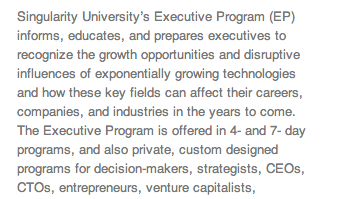
Last week at the invitation of my friend, Vivek Wadhwa, who is VP of Academics and Innovation at SU, I attended a seminar there, a part of their special Executive Program. As you can see from their website blurb on the right, this program is designed to acquaint key decision makers with the latest exponentially growing technologies. The technologies are presented at SU by scientists and entrepreneurs who are already developing tomorrow’s products and changing the landscape of possibilities for the U.S and the world.

The seminar was on the future of Health and Medicine, and was conducted by Dr. Daniel Kraft, Chair of the Medical Track at SU, and a Stanford and Harvard trained physician, scientist, entrepreneur and innovator.

Dr. Kraft presented a dazzling vision of a coming revolution in medicine driven by exponential growth in the so called GRIN technologies: Genomics, Robotics, Information technology and Nanotechnology. What is promised is a stunning new age in healthcare of low cost, personalized modern treatments and access for billions within a decade! This imminent revolution includes:

iPhone product by Netra for eye testing.

  • Mobile phone as a personal medical lab,
  • ubiquitous imbedded medical intelligence
  • zero-cost diagnostics,
  • mobile devices that can diagnose a patient better than a group of board certified doctors (I believe an X-prize of $10,000,000 is being offered for this goal).
  • an “OnStar” system for the body for remote medical monitoring
  • Surgical Robotics
  • Regenerative Medicine including custom manufactured body parts built using molecular technology or stem cell technologies

His vision is presented in this TED video.

These ideas are not some future pipe dream – they are being developed and implemented right now. In five to ten years the landscape of healthcare and medicine will be completely changed to a new paradigm dubbed Healthcare 2.0.

Here’s a brief taste of devices and technologies already built:

Mobile Phone as a Personal Medical Lab

Already there are 20,000 Apps for medicine on the iPhone and Android phones! Tests and diagnostics that you can do today:

iphone controlled blood pressure monitor

iPhone Glucometer for measuring blood sugar

  • Monitoring Blood Pressure
  • Blood Glucose Measurement/Diabetes Management
  • Realtime EKG
  • Sleep Monitoring
  • Ultrasound
  • Eye Testing
  • Skincare, ADHD testing, Ear and Hearing related, Renal Symptoms and many others.

The results of these tests can be continuously generated and stored for real time, preventive or post disease monitoring.

Other Zero Cost Diagnostics

To name a few:

  • Portable X-ray machines the size of an iPhone ($1 per X-Ray) using luminescent scotch tape!
  • Lab-on-a-Chip, such as Gene-RADAR, developed by Dr. Anita Goel, Nanobiosym, that can detect the RNA/DNA signature of any pathogen in your system, named and reported to a central computer. Virtually costless.
  • Genetic analysis and Genome mapping to facilitate personalized treatments. The cost (companies like 23andme) has come down to a mere $100 for a complete genome mapping soon to be under $1.
  • Smart Toilets – stool and urine daily testing and data storage. Get your poo log (actual name of product) data analyzed.

Ubiquitous Medical Intelligence

  • Detailed User’s Manual and treatment plans personalized for your body on the web.
  • Predictive Health for you with prevention strategies
  • Augmented reality for the body
  • “OnStar” remote help
  • Routine surgeries via remote robotics. Already 80,000 cases per year!

Regenerative Medicine

3-D Organ "Printer"

  • 3-D printing of organs
  • Regenerative cell therapies
  • Stem cells – bone marrow mining and baskets of bio-manufactured human parts!

You get the idea. It’s huge, what’s going on. We have the potential to use exponentially growing, convergent technologies to provide universal healthcare of unprecedented quality and individualization at very low cost. We can overcome a shortage of doctors and specialists and create a world where humans are connected with one another and contribute to the general wellness of billions!

Posted in Current Events, Healthcare, Innovation, Investing, Medicine, Money, Science | 5 Comments

The Laziest Investment of All

In today’s financial column on CBS’s MarketWatch, Paul B. Farrell writes about “Lazy Portfolios” – i. e. Buy-and-Hold long term, “lazy” strategies that always beat brokers’ and advisors’ more aggressive, managed strategies.

Here’s an excerpt of what he says:

“America’s investors have been ripped off as massively as a bank being held up by a guy with a gun and a mask,” …

Lazy Portfolios give investors a far superior alternative than gambling retirement savings in Wall’s Street’s casino. Simple solutions: Just three to 11 no-load low-cost index funds, and zero trading. And in the past decade we’ve discovered eight great Lazy Portfolios that investors are using as guides to building their own portfolios, without brokers or advisers.

Today, Wall Street, the fund industry and brokers hate these eight Lazy Portfolios even more. Not just because they consistently beat the S&P 500 on a long-term basis. Not because they’re based on the exact same Nobel Prize-winning model Wall Street’s top wealth managers use. Not because you don’t need any fancy algorithms to rebalance your portfolio. And not because Bogle calls industry insiders casino “croupiers” because they skim a third of your market returns off the top, leaving you leftover crumbs.

The more you trade at Wall Street’s casino, the richer your broker gets.

Farrell suggests that you build your own lazy portfolio using just a few index type mutual funds with low loads. Low loads are important, he says, because a typical mutual fund silently skims off about a third of your return, with no great benefit to you but a lot of benefit  to your advisor/broker. He offers six principles of sound investing – all of which are just one principle stated six times: You can’t time the market and you can’t beat the average. You must avoid getting effected by short-term swings and market sentiment. Have a definite time horizon for your investments and you will beat the experts. Don’t even watch the market and your portfolio day to day and have realistic expectations.

Read Farrell’s article here.

Farrell then goes on to give an example of 8 mutual funds that would be great candidates, singly or together, for a lazy portfolio. These are summarized below along with their 1-, 3-, 5- and 10-year returns.

He notices that they beat the S&P 500 over 5 or 10 years.

Mirror Mirror on the Wall. What’s the Best Fund of them All?


As you may know from reading my previous columns I think that the best investment vehicle of all is the simplest index of them all – The Dow Jones Industrial Average, or the Dow as we familiarly call it.

As of this writing how did the Dow fare over the same periods? Here’s how:

Dow Jones Industrial Average with Dividends Re-invested
1-year           11.6%
3-year           22.8%
5-year             4.3%
10-year           5.0%

Over 1-, 3- and 5-year periods the Dow beat all 8 of the lazy portfolios suggested by Farrell. Over the 10-year span the Dow did a bit worse. Over longer spans – 15, 20, 30 or 40 years – the Dow has returned a whopping 11% annual return compounded!

The Dow is easy to invest in – you could buy the ETF with the symbol DIA. You will pay a 0.5% or less total annual fee. Be sure to reinvest dividends automatically.

If you want to save the fee you just need to buy the 30 component stocks – equal shares of each. That’s it. You’re done. Reinvest dividends, and if buying 30 stocks with periodic dividends is too much work, sweep the dividends into DIA.

You will have less volatility than all the 8 “lazy” portfolios mentioned by Farrell and you will have comparable to better results. Best of all you need not waste your time studying and timing, or even watching, the market casino. You will be getting the best returns the house has to offer without making the sharks rich.

Posted in Current Events, Investing, Money, Politics | 1 Comment

Our Human Future – Green, Healthy, Prosperous, Abundant!

Sugata Mitra

Thank God we have people like Sugata Mitra. Or Peter Diamandis. Or the hundreds of other pioneers who think like them and are transforming the world for the better. They have a vision of boundless optimism: a world of plenty, unlimited resources and resourcefulness, and an earth that comfortably yields cheap and renewable abundance for all of mankind, soon to top out at 9 billion people on our little planet.

Peter Diamandis, Chairman and CEO of the X-Prize Foundation, is also a cofounder of the Singularity University (SU) in Silicon Valley and the author of the book, Abundance. The Future is Better Than You Think. In this book he describes the vision mentioned above: of transformations and exponential innovation that will result in a world that is connected, healthy, sustainable, educated and prosperous. This is not just a dream for a utopia someday far in the future – this is a blueprint eminently achievable well within one generation. Peter’s goal in founding SU, as he says in his book, is to propagate this vision and spawn at least one company that will directly and positively impact one billion people.

Who will be the first one to do that?

One likely candidate is Sugata Mitra. He is an educator and a scientist who tackles one of the greatest problems of education — how to educate a billion kids in this world where we have a great shortage of teachers and schools. Self-directed learning was a possibility in his mind, but were kids living in slums, with no education, language, access to teachers and schools capable of all that much self-direction?

He did a series of real-life experiments in India that could revolutionize how we think about teaching. Please see the TED video below – it’s uplifting and amazing!

Slum Children at Mitra's Computer

In a New Delhi urban slum Mitra cut a hole in the boundary wall and installed a computer with the screen facing the slum. A track pad allowing point and click was attached. The computer was connected to the Internet and had a web browser. Mitra installed a video camera to record the results and walked away.

The kids living in the slum could not speak English, did not know how to use a computer and had no knowledge of the Internet, but they were curious. Within minutes children of the slum had learned to click and browse the Internet. Groups gathered and soon the kids were trying different experiments and teaching one another how to use the web. This raised a lot of questions in Mitra’s mind. Was this real or was someone out of sight of his camera explaining the technology to them?

He repeated the experiment with many variations. One amazing experiment was in the village of Kalikkuppam in Tamil Nadu. Mitra set himself an “impossible” target: (as he puts it, see his Ted talk in the video below) – can a bunch of impoverished, Tamil-speaking, twelve-year-olds, learn to use the Internet in English, and teach themselves biotechnology? Yes, biotechnology – this guy does not think small!

“All I told them, ” he says, “is that there was some very difficult information on the computer and that they probably would not understand it.” And that he would be back in a couple of months to test them.

When he returned and asked them if they had learned anything, one 12 year old girl raised her hand and said, “We learned nothing.“

He was somewhat disappointed and asked them when they had stopped trying to learn on the computer realizing that they had learned nothing. The girl said they were on the computer every day. ”But you learned nothing at all?“ asked Mitra.

“We learned nothing …… except that improper replication of the DNA molecule causes genetic disease.” He was agape. Actually the kids had learned a lot more than that. When Mitra tested them they scored 30% on a standard test given to kids who attended formal school. 0% to 30% in two months with no formal education! Wow!

Mitra kept refining the process. By adding an elderly person to encourage the kids and give them feedback (a grandmother, if you will, who didn’t need to be proficient herself) he was able to increase the test score to over 50% (better than at formal schools) and best of all the kids retained what they had learned when he came back and tested them several months later without a computer!

Sugata Mitra’s “Hole in the Wall” experiments have shown that, in the absence of supervision or formal teaching, children can teach themselves and each other, if they’re motivated by curiosity and peer interest. Ever the scientist Sugata Mitra concludes:

Education is a self-organizing system and shows strong emergence.

Since then Mitra has formed schools all over the globe called SOLE’s (Self Organizational Learning Environment). He enrolled real grandmothers from the U.K. and India to act as mentors via a Skype type hookup to these schools, each of which can educate 100 kids.

Mitra’s goals are nothing short of audacious:

  • Educate 1 billion children around the third world
  • Use 100 million mediators (grandmothers and such, easily available if can be used remotely
  • Establish 10 million SOLEs.
  • Cost: $180 billion
  • Time to achieve: 10 years!

Now that’s visionary and, in this world of naysaying, a huge blast of fresh air!

Posted in Current Events, Education, Evolution, Money, Science | 5 Comments

Photosynthesis – A Bright Ray of Hope in our Energy Future

Cyanobacterium call

Last Thursday, invited by my friend Sam S. Vasan, I attended a dinner meeting of the AIChE ( American Institute of Chemical Engineers) held in Walnut Creek. The speaker was Prof. Anastosias Melis, a Biochemist from U. C. Berkeley, and the topic was Photosynthesis-to-Fuel.

Professor Melis presented the results of his research in which he is genetically modifying bacteria to directly convert sunlight into hydrocarbons. This technology has a lot of promise and is on the doorstep of commercialization. If implemented it can provide us with a solar source of energy that has big advantages over photovoltaics in cost and storage.

Blue-green Algae Growing Naturally

Blue-green Algae Growing Naturally

The key player in this technology is a single cell creature,  called cyanobacteria, that is mass produced in nature as blue-green algae. It blooms fast and abundantly on bodies of water, such as lakes and seas – creating a blue-green scum like appearance.

This little organism has developed a fantastic trait –  photosynthesis, which means it uses chlorophyll (and carbon dioxide and water) to gather light and convert it to energy. Once the conversion is complete, the organism stores that energy as sugar, while releasing oxygen as a byproduct.

Blue-green algae in various forms are responsible for about 20% of all solar energy conversion to bioenergy in the world. Their total production is 450 trillion watts or (TW), 24 hours a day as there is sunshine somewhere all the time. Compare this with peak energy usage by mankind of about 8 TW.

These algae also use up CO2, which solves yet another problem for us – carbon induced global warming. (The carbon is released back when the photosynthetic fuel is burned, so no net carbon released into the air for the cycle).

The trouble with the photosynthetic activity of these cyanobacteria is that they produce sugars and  other products not easily usable by our industries as energy sources. What if we could induce these organisms to directly produce hydrocarbons that we can burn in cars or generate electricity with? It would be a great, non-polluting assist to our energy needs.

Genetically Modified Algae Produce Hydrocarbon Fuel Directly

Professor Melis described how his research has produced  genetically modified cyanobacteria that can do just that – they can modify the products of their photosynthesis to produce a hydrocarbon called isoprene (C5H8) which is easily storable as a liquid without having to freeze it (it boils at 34°C or 93°F). The algae cells still produce sugars and other biomaterials they need to replicate and live, but 16% of their sunlight conversion now goes into the usable hydrocarbon. See Prof. Melis’ paper describing his research here.

Professor Melis, to show scalability of his lab results, built a “bioreactor” in his backyard which uses a cubic meter of algae, CO2 (in Baking Soda form), and water to produce and trap hydrogen. He used stock materials picked up in a hardware store and aquarium supplies. He has since refined the process to produce the more usable isoprene instead of hydrogen, which is difficult to handle. His gizmo can provide clean energy, sufficient enough to supply an individual household needs, any place the sun shines.

The results of this and related research have excited many investors/entrepreneurs and Prof. Melis says he is receiving numerous inquiries from venture capitalists. The economic tipping point for commercialization, he says, is a production ratio of 20% isoprene. He is still tinkering with the algae genetics and other parameters to achieve that result, which he says is within sight.

The advantages of photosynthesis over photovoltaics are:

  • No expensive manufacturing or rare earths required. The cyanobacteria once genetically modified, can replicate themselves fast and indefinitely.
  • No battery technology with its attendant bulk and disposal issues
  • The hydrocarbon produced is very versatile and can be used in many industrial processes directly. It can be stored much more easily than, say, hydrogen in liquid form and shipped safely.

An Algae Bioreactor

The bioreactors can be built in remote or waste areas where the sun shines and algae reactor farms can be built. Transmission lines are not required as for photovoltaic electric generation plants. The costs have been estimated as low: just a few cents for a gallon equivalent of gasoline, if a viable, scalable technology is implemented.
This is not some pie-in-the-sky radical environmentalists’ pipe dream. It is mostly here and has great promise.

Wanna do a new start-up?

Posted in Uncategorized | 4 Comments

Resurrection – A Natural Adaptation in Yellowstone!

At Yellowstone Park (see my photo essay of recent trip) winter is a time of survival. The conditions are harsh and life must adapt to survive. In fact after the long, cold winter many animals who are at  less-than-peak fitness die and springtime reveals thawed out expanses littered with dead animals.

The woolly shag of the bison keeps it well insulated. Photo by my colleague, Larry Porter

So nature has devised strategies for survival. The bison, for example have developed a dense shag and a dark color that absorbs almost all of the precious sunlight. They can continue to forage under the snow on soggy grasses, unless there’s a very hard freeze, in which case they cannot push the snow aside to reach the grass, and cannot eat. They have lots of body fat stored and can run temporary deficits in calories to survive.

Other animals, such as the grizzly bears, hibernate through the winter to conserve energy. Marmots go into deep hibernation, reducing their metabolism by 80%. The sleep is so deep that they cannot be woken up during hibernation.

A Frozen Frog in Yellowstone National Park

But the most astonishing strategy is adopted by the boreal chorus frog (and some of his kin in other parts of Montana and Canada, such as the wood frog). The boreal frog literally allows itself to “die” for the winter! As winter approaches it creates a shallow burrow of dead leaves, sneaks underneath and freezes over. Literally, it looks like a chunk of ice in the shape of a frog. Its metabolism stops – no heartbeat, no blood circulation, no oxygen transport. No respiration. All the functions that we associate with life are absent. It’s not merely hibernating, it is almost literally dead. You can kick one and it will be like you kicked a block of ice.

Then, when the thaw sets in at winter’s end, the boreal frog miraculously resurrects itself! The water in its body melts again and it somehow restarts its heart and metabolic activity. It’s alive again! This is not waking up from deep hibernation, this is resurrection from the dead!

For normal living beings like you and me, if we froze the water in our body cells, the cells would explode and die. There would be no building them back again. But the boreal frog has adapted by developing a special gene that sets processes in motion to expel all the water from the cells and lets the water freeze outside its cells. The cells are completely desiccated and inert during the freeze but they are technically still “alive”. After the thaw the gene sends a signal to restart the heart and for the water to rehydrate the cells. Viola! A live boreal frog ready to feast on the plentiful mosquitos and other insects of spring and summer.

Nature is magical. There is evolutionary beauty and elegant solutions to impossibly harsh environmental challenges. Somehow life clings to every niche no matter how inhospitable. The boreal frog, whose habitat we were lucky enough to visit, is a wonderful example.

Posted in Evolution, Photography, Science, Travell | 7 Comments

Winter in Yellowstone: A Place of Exquisite Beauty

Bison Grazing in a Snowstorm

Last week, along with a dozen other photographers, I made a trip to Yellowstone National Park. I found winter in Yellowstone to be a unique experience: it was cold, harsh, snowing. Temperatures ranged from -15°F to +20°F – even colder with a whipping wind – but it was also serene, starkly beautiful and unspoiled. No bustling tourists that you see in summer, just you and the sounds and sights of nature in hibernation or survival mode.

Snow Coach

The park is closed to all cars in winter. We traveled by a Snow Coach, a vehicle with a tractor drive, specially chartered for the purpose. Along with snowmobiles it is the only way to access the icy, snowed-in park roads. It trudges along at 15-20 MPH and provides ample time to soak in the winter beauty of the Yellowstone plateau which rises 6000 to 11000 feet above sea level.

A Frozen Walk to Midway Basin, Yellowstone NP

Yellowstone is the first National Park in the U. S. It was so designated in 1872 by President Ulysses Grant. The concept of a National Park was mandated for the first time – a wilderness and biosphere reserve to be maintained in unspoiled form for the enjoyment of the people. It is also huge, encompassing more than 2 million acres or about 3500 square miles (larger than Rhode Island and Delaware combined).

It boasts the largest caldera of a volcano on earth, and while the volcano has not erupted full bore since 640,000 BC, simmering volcanic activity is still very much evident, as the hot spot just below a thin crust of earth sends up plumes of gurgling steam, erupting geysers and boiling mudpots. In winter the icy landscape is covered with a steamy vapor from all the hydrothermal activity that dominates the lava dome in the huge caldera.

Music Video of Photos and some Video Clips:

Old Faithful

Yellowstone has some 10,000 hydrothermal features, about two thirds of all such features in the world! The most famous, of course is the Old Faithful geyser which has been erupting faithfully every 93 minutes, year in and year out. See slideshow from trip.

Near this famous geyser is the origin of the Firehole river, which is fed by hundreds of hydrothermals creating a steaming, vaporous, fuming river, which never freezes as it runs through an icy landscape in temperatures sometimes as low as -60°F.

Clouds of Steam Over Firehole River

The Yellowstone River also originates in the park and flows into Montana and eventually into the Missouri river. It is huge – bigger than the Missouri and, had it been discovered before the Missouri, the biggest river system in the U. S. would properly have been called the Yellowstone river instead of the Missouri/Mississippi.

Lower Canyon Falls

The Yellowstone River forms a magnificent canyon – known as the Grand Canyon of the Yellowstone – flanked by the majestic lower canyon falls. The Grand Canyon runs for 26 miles and is more than a quarter mile deep encompassing a sharp icy drop to the river from the towering mountains of the Yellowstone plateau.

The Grand Canyon of Yellowstone

You see many animals wintering in the park. There are bison, their shags all covered with snow, rooting in the snow for the soggy grasses beneath. You also see the beautiful red fox, elk, coyote, trumpeter swans and, if you’re lucky, wolves.

Trumpeter Swans in the Steamy Madison River

Lots of beautiful pictures to share from this memorable trip. Please check out a slide/video show here.

A Red Fox Checks Us Out

It was a great week at Yellowstone National Park. My toes are still thawing out but it was well worth the discomfort. The mind was feasted with a landscape displaying its stark beauty and a bioscape of ethereal charm.

Posted in Photography, Science, Travell, Uncategorized | 21 Comments